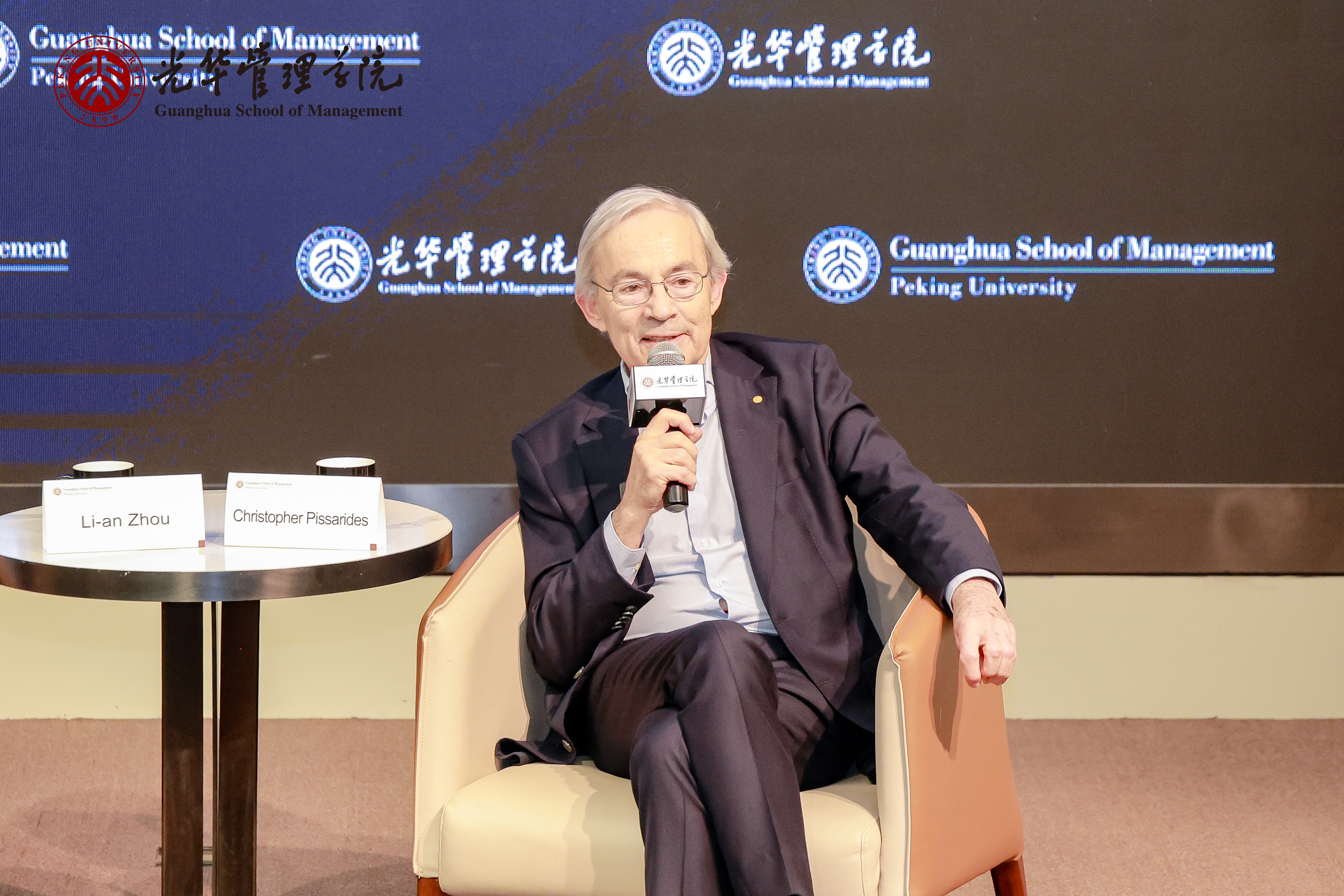
Christopher Pissarides delivered a lecture at Guanghua School of Management titled “AI Disruptions in Labour Markets” on March 20.
Peking University, March 23, 2026: The world's workers are afraid. Survey after survey shows employees worried they will be displaced by artificial intelligence. Christopher Pissarides, Nobel Laureate in Economics and Regius Professor of Economics at LSE, thinks they are asking the wrong question.
"Some jobs will be lost. Most jobs will transition to doing something else," he said in a lecture delivered at Peking University Guanghua School of Management on March 20. "If we do it properly, there isn't going to be any mass unemployment."
A pioneer in labour economics, Pissarides has spent his career studying why economies are slow to absorb shocks. His core argument is that AI is not a force of destruction but of disruption, and the difference hinges on how well governments, companies, and workers manage the transition.
His framework starts with a simple reframe: stop thinking about labour in terms of hours, and start thinking in terms of jobs. A job is a bundle of tasks, and AI touches those tasks unevenly. Manufacturing adopted robots faster than services because assembly line work could be broken into discrete, automatable steps. Services are different. The bank teller lost her role processing cash, but in her place emerged the relationship manager, someone whose job is to make customers feel heard. No machine, Pissarides noted, can do that convincingly.
"Whatever happens, the human is the boss. AI cannot do things on its own."
He identified three frictions slowing the labour market's response to AI. The first is information: uncertainty about where new opportunities lie causes paralysis. The second is location: AI innovation clusters around a handful of cities, from San Jose and Boston to Beijing and Shanghai. The third, and most significant, is skills.
Unlike earlier industrial revolutions, the AI transition demands cognitive upskilling. The skill that matters most is not the ability to build AI but to use it well. Understanding what AI can do is more important than writing AI programs. "A world-class chef does not need to know how her knives were forged — what matters is the recipe and the instinct behind it."
This has real implications for education. Pissarides endorsed STEM teaching but warned against over-specialisation: technology changes too fast, and AI is already strongest at the very technical tasks STEM produces. The more durable investment is in learning how to learn. Skills like communication, critical thinking, and empathy — these are the skills AI cannot touch, and that, he said, is precisely where the human advantage lives.
Data from a survey of five thousand workers reinforced this notion. Salary ranked lower than expected. What workers valued most was honest communication, meaningful colleague relationships, and flexible working. What they feared most was surveillance, abusive customers, and replacement. Companies that invest in training and design humane workplaces, he argued, will be the ones that thrive.
His conclusion was quiet but urgent. The question is not whether AI will reshape work. It will. For students, his message was a rebuke to anyone tempted to abandon soft skills: in a world where machines outperform humans on most technical benchmarks, the human advantage lies in exactly what cannot be replicated.
"The biggest challenge," Pissarides said, "is the smooth transition."
Written by: Khor Hui Min, Lim Wei Urn
Edited by: Chen Shizhuo