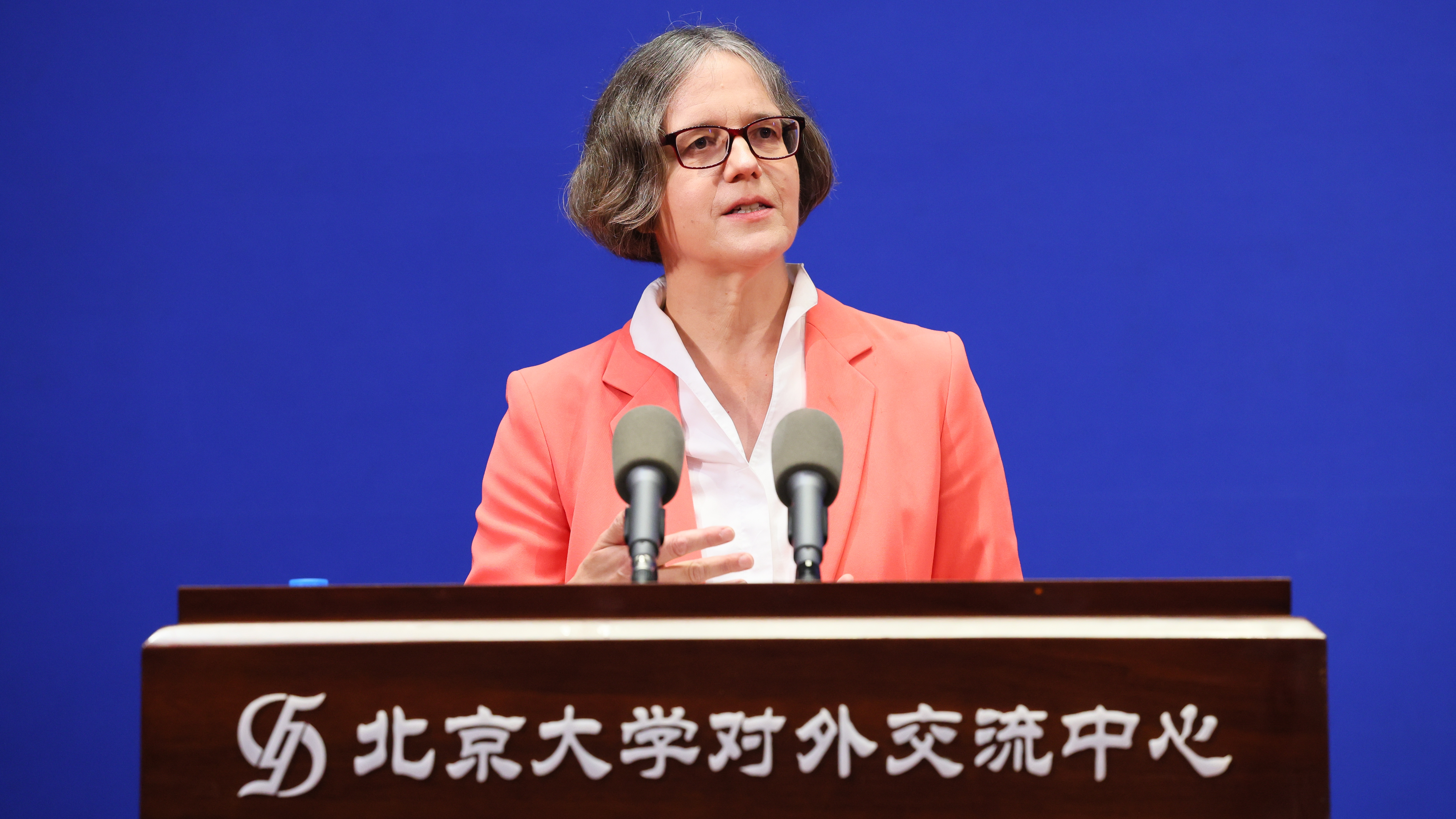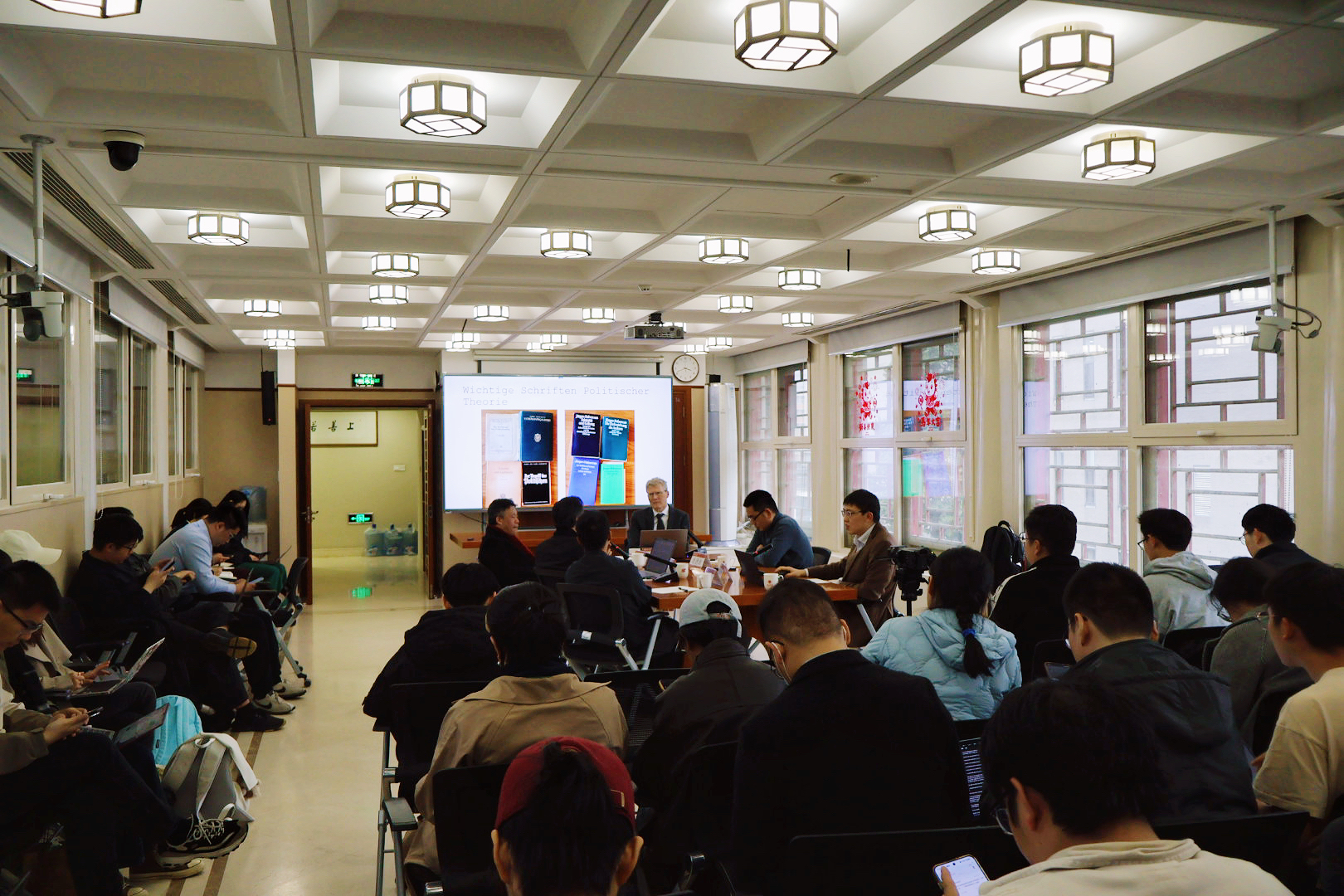
Reinhard Mehring delivered a lecture at Peking University titled "Imagining Two Futures of Europe: Habermas vs. Schmitt" on April 9.
Peking University, April 15, 2026: Is the future of Europe shaped by rational consensus or sovereign decision? In a lecture at Peking University, Reinhard Mehring, a German political scientist and Professor of Political Science at Heidelberg University of Education, brought the opposing visions of Jürgen Habermas and Carl Schmitt into sharp relief.
Habermas (1929-2026), who passed away just a month before this lecture, was Germany’s most influential philosopher and social theorist in the tradition of critical theory and pragmatism. Schmitt (1888-1985) was a controversial jurist who argued that all politics rests on distinguishing friends from enemies. Their opposing views on law, sovereignty, and Europe have shaped decades of political theory.
For Habermas, the European project offers a historic chance to transcend the nation-state. In works like
Between Facts and Norms (《在事实与规范之间》), he argues that constitutional legitimacy rests on communicative reason and the internal unity of popular sovereignty with fundamental rights. Law must trace back to rational consensus. Schmitt, the right-wing jurist, rejected this entirely. In
Legality and Legitimacy(《合法性与正当性》), he insisted that a constitution’s essence lies not in its articles but in the political decision that precedes all norms. That decision shapes the political identity through the distinction between friend and enemy.
Mehring, a leading Schmitt biographer, distilled their opposition clearly. “The fundamental divergence between Schmitt and Habermas,” he said, “lies in the ultimate interrogations between power and law, morality and politics, realism and idealism.” While Habermas insists on the priority of norms, Schmitt focuses on the existential conditions of political unity. For Schmitt, the key question is whether the EU possesses the internal homogeneity or common will necessary for a genuine political alliance.
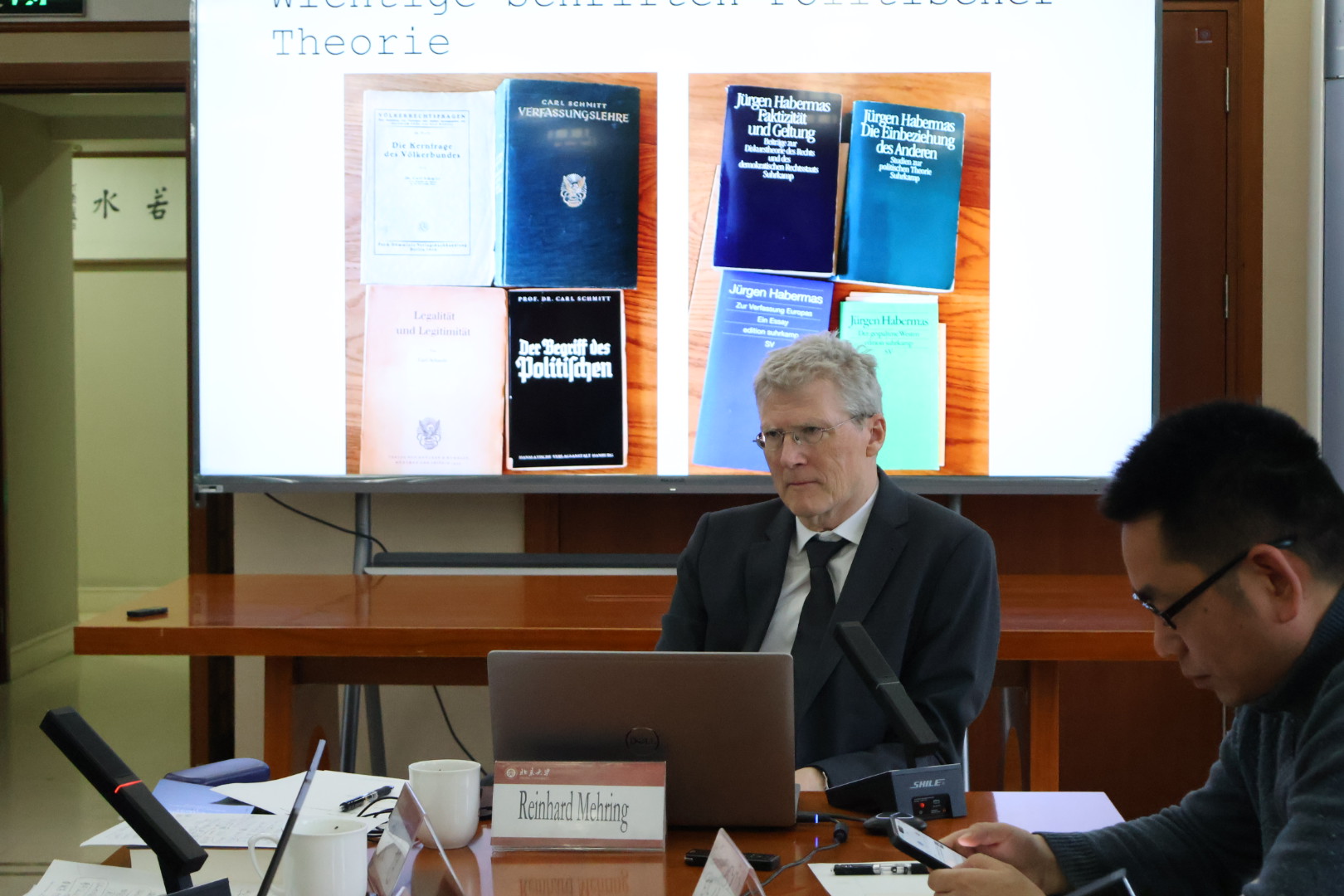
Reinhard Mehring speaks at the lecture.
Yet Mehring also pointed toward possible common ground. Both thinkers, Mehring noted, are committed Europeans who share a critical view of external hegemony. Both recognized that rights depend on effective political order. Schmitt called this the relationship of “protection and obedience,” while Habermas later became concerned with legitimation crises.
During the discussion, Professor Zhang Xu from Renmin University of China proposed a “militant constitutional patriotism.” This idea would take Habermas’s normative ideal as its core while borrowing Schmitt’s realistic sensitivity to political conflict. Whether such a combination is possible remains an open question. But as Mehring concluded, their opposition continues to generate Europe’s most essential debates about what kind of political community it ought to become.
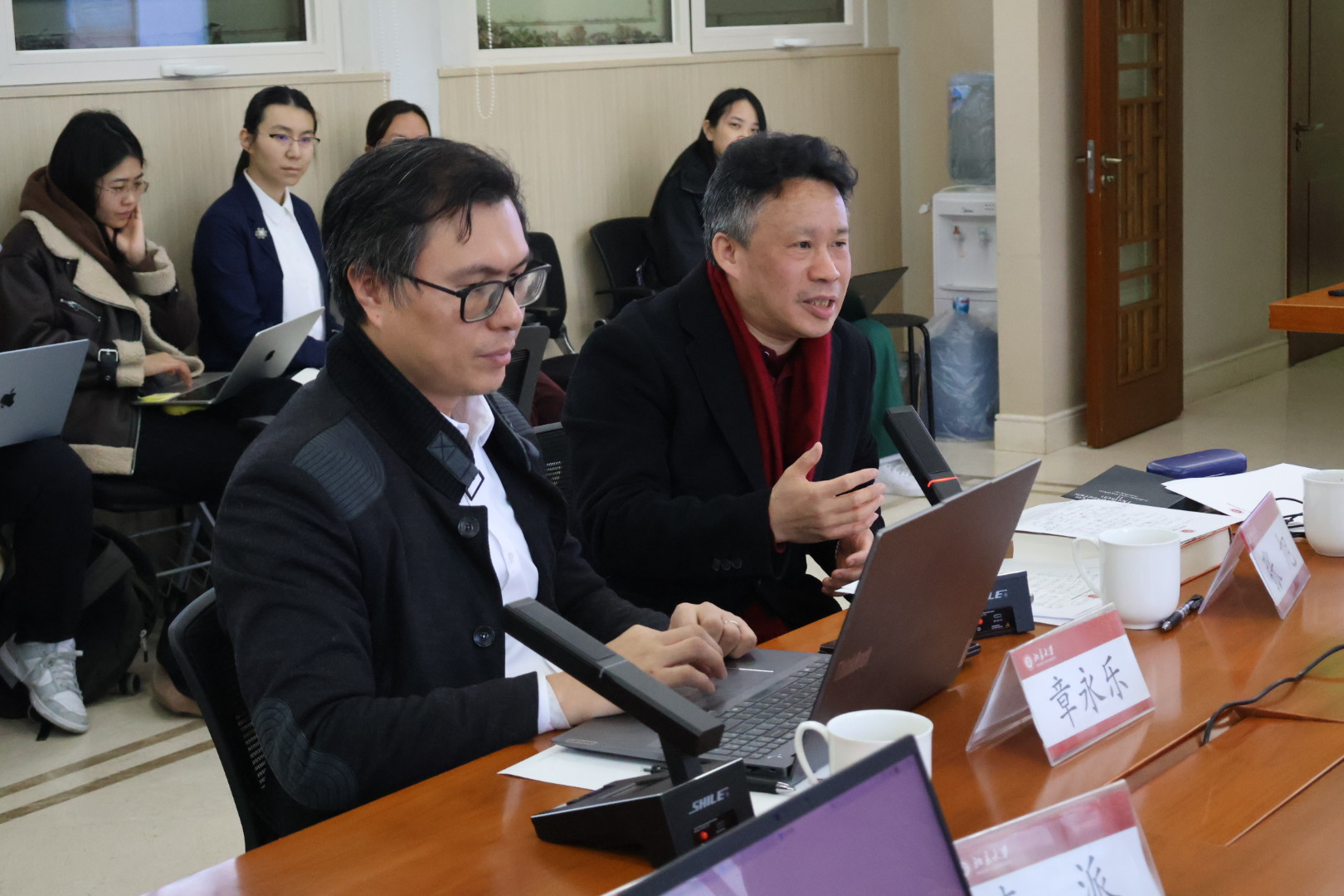
Professor Zhang Yongle and Professor Zhang Xu speak at the lecture.
Professor Zhang Yongle from Peking University Law School then offered a reflective comment from a global perspective. He reminded the audience that both Habermas’s universalism and Schmitt’s theory carry hidden assumptions about center and periphery. The attempt to combine them, while intellectually appealing, must remain alert to how such frameworks have been interpreted and used in different historical and regional contexts. His intervention added a necessary note of caution to any straightforward combination.
Reported and Written by: Cui Anyi
Edited by: Chen Shizhuo
Photos by: Cui Anyi