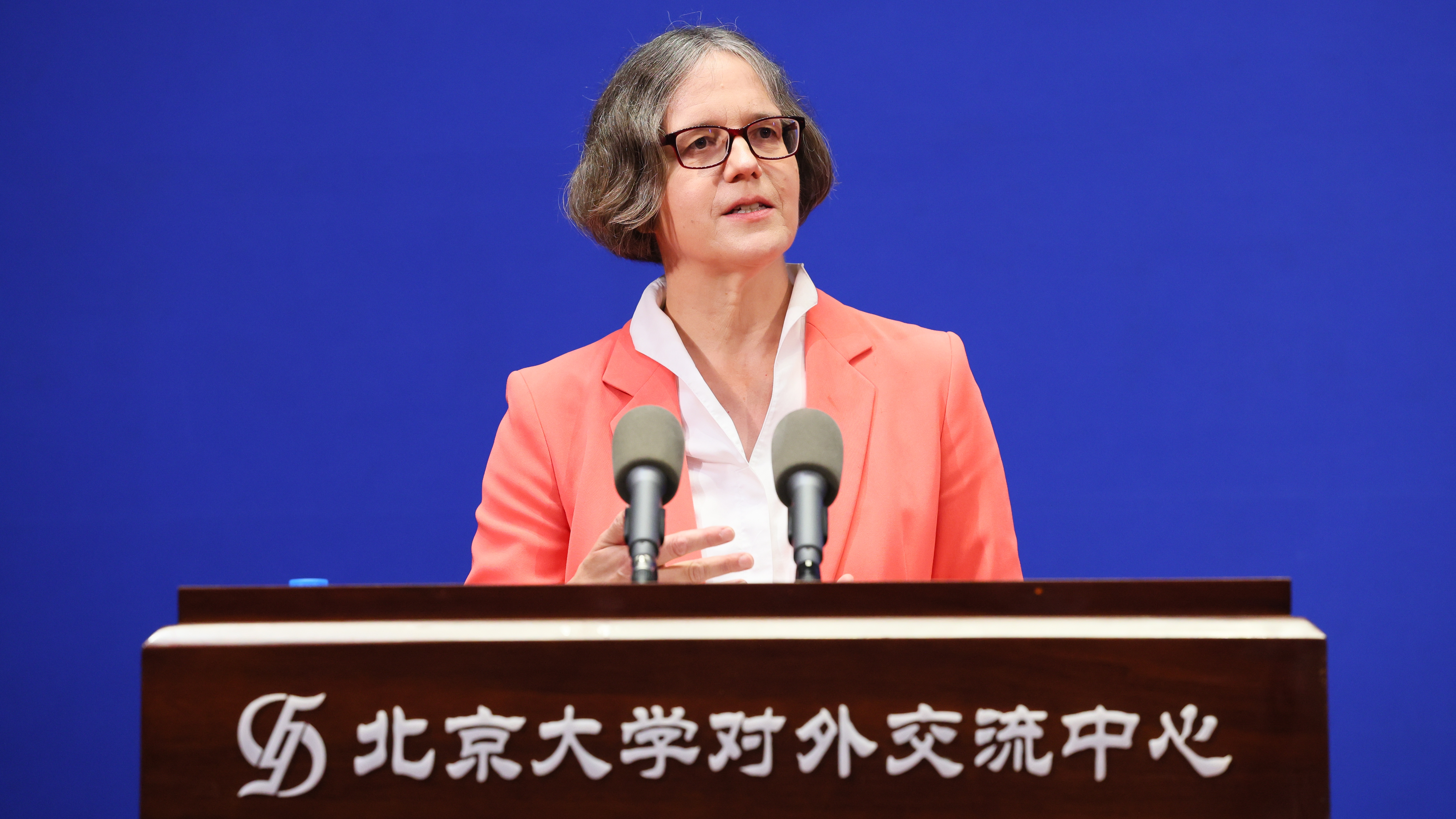
Peking University, May 1, 2026: For most people, time is measured in seconds. In Anne L’Huillier’s lecture, however, the meaningful unit was the attosecond, an almost unimaginably short slice of time that allows scientists to probe the motion of electrons inside atoms. In a lecture titled “The World of Atoms at the Attosecond Time Scale,” delivered on April 23 at Peking University, the 2023 Nobel Laureate in Physics traced the scientific path that made attosecond physics possible, from the invention of the laser to the development of tools capable of observing electron dynamics on their natural timescale. The lecture was part of the PKU Global Fellowship.
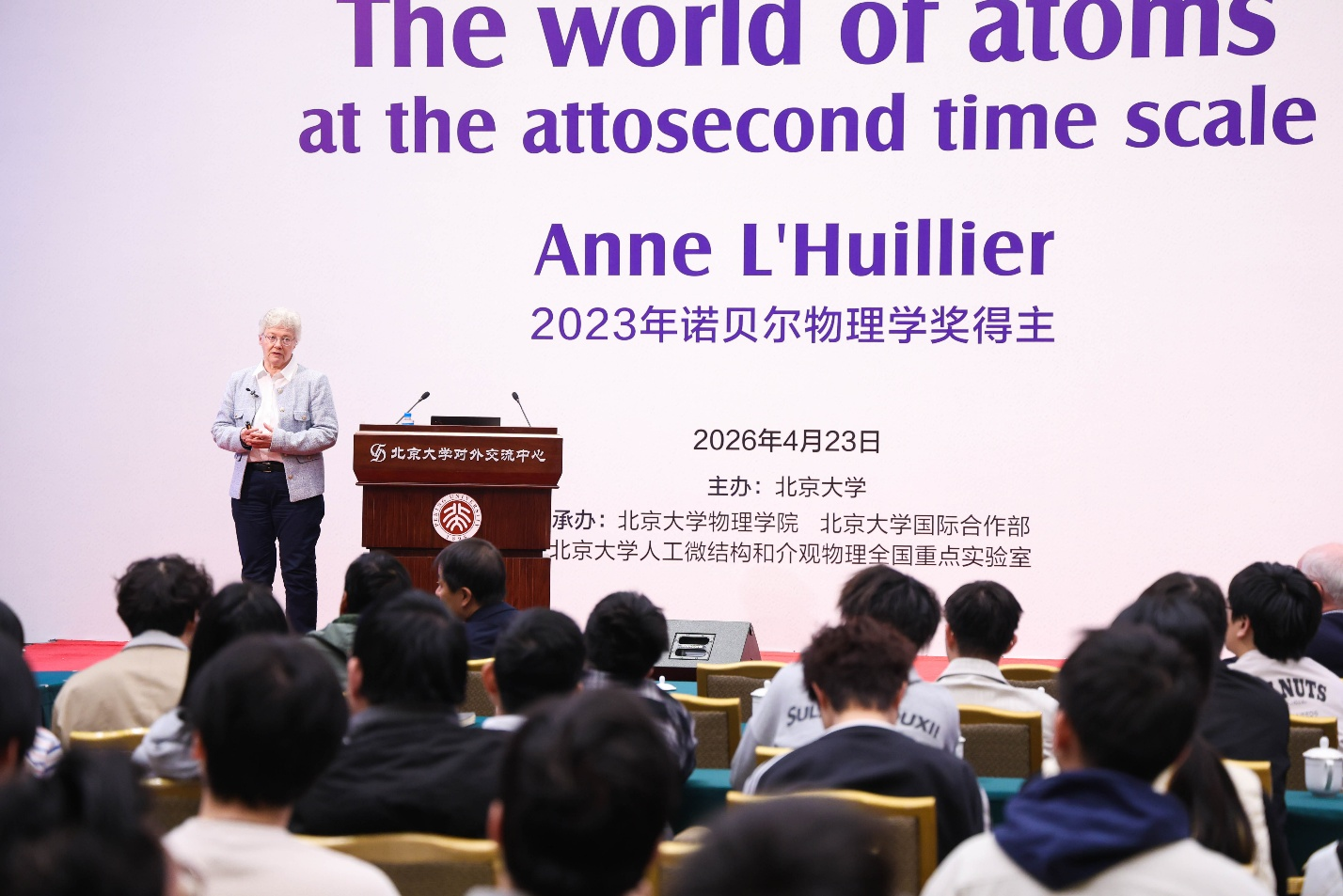
2023 Nobel Prize in Physics Laureate Anne L’Huillier.
She began by placing attosecond physics within the hierarchy of natural timescales: mechanical motion occurs in milliseconds, electronics in nanoseconds, molecules in femtoseconds, and electron motion even faster, on the attosecond scale. Capturing such ultrafast processes requires laser pulses with extraordinary temporal precision. The lecture unfolded in three main parts: high-order harmonic generation (HHG), attosecond pulse generation, and the use of these tools to probe electron dynamics.
L’Huillier traced the field back to the invention of the laser in 1960, which opened new areas of research, including nonlinear optics and multiphoton physics. In one early experiment, her group unexpectedly discovered high-order harmonic generation while studying fluorescence, a result that later helped make attosecond pulse generation possible.
She explained that when these harmonics are phase-locked, they combine into ultrashort bursts of light in the attosecond regime. To illustrate this, she introduced the three-step model: an electron tunnels out of the atom, is accelerated by the laser field, and then recombines with the parent ion, emitting high-frequency radiation.
L’Huillier also stressed that generating these pulses is only part of the achievement. Using techniques such as RABBIT (reconstruction of attosecond beating by interference of two-photon transition) and laser-assisted photoionization, scientists can measure timing and phase information in electron dynamics, including tiny delays in photoionization processes in xenon.
Her conclusion looked beyond the atomic scale. Attosecond science, she noted, is now expanding into chemistry, condensed-matter physics, quantum information, and even semiconductor inspection. Yet one of the most memorable moments came during the discussion session, when she reflected on the emotional reality of research itself. Unexpected results, she said, are part of discovery, and progress often requires persistence: “You need to be a bit stubborn.”
Reported and written by: Akaash Babar
Edited by: Chen Shizhuo