Peking University, June 18, 2026: A forest can store carbon. A mangrove can protect a shoreline. A wetland can regulate floods. An urban green space can cool a city. Taken separately, these may look like environmental projects. But taken together, as Erik Berglof shared, they reveal something larger: nature itself can function as infrastructure.
At the lecture "From Investing in Energy to Nature: The AIIB Way," held at Guanghua School of Management on June 16, Erik Berglof, chief economist of the Asian Infrastructure Investment Bank (AIIB), explored how this rethinking is reshaping the role of infrastructure investment and sustainable finance.
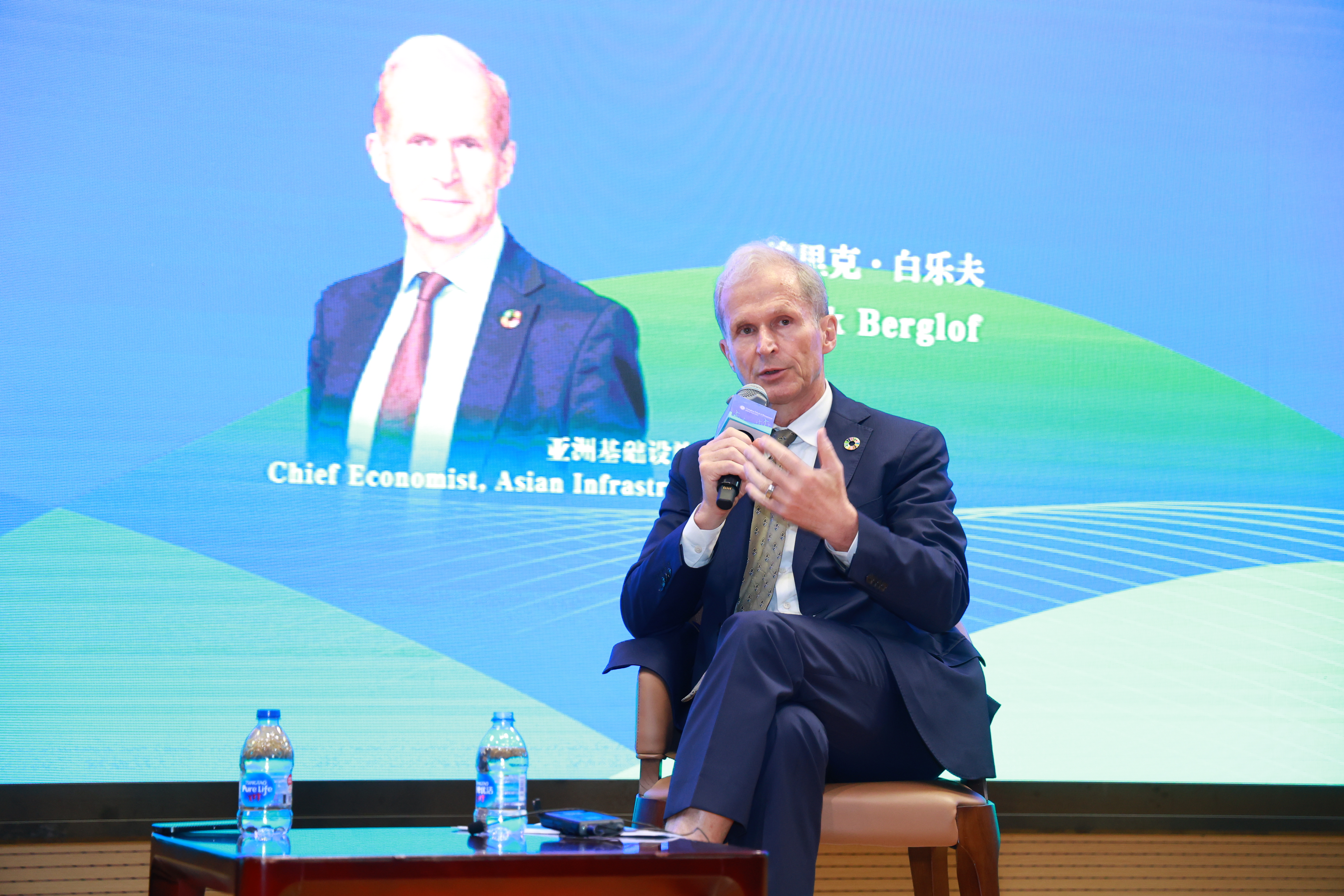
Erik Berglof delivered a lecture at Guanghua School of Management titled "From Investing in Energy to Nature: The AIIB Way" on June 16.
He laid the foundation by distinguishing between "nature-based solutions" and the broader idea of "nature as infrastructure." While nature-based solutions often refer to targeted interventions, such as restoring a mangrove or planting urban greenery, nature as infrastructure asks how entire ecosystems can be restored, managed, financed, and valued for the public and economic services they provide over time. He illustrated this concept through an example of "flying rivers", explaining how forests, such as the Amazon, transpire moisture into the atmosphere, helping supply rainfall to farms and cities far beyond their borders. This means that when we destroy a forest, we do not simply lose trees—we might be disrupting a freshwater system that crosses borders and sustains economies far beyond the forest's edge. The example helped showcase how finance can better value and protect natural systems that sustain agriculture, cities, and economies across vast distances.
Berglof described AIIB's approach as seeking to build the conditions for scaling such investments through policy-based financing, private-sector engagement, local financial capacity, and bankable frameworks. He added that AIIB's objective is not simply to maximize returns, but to "maximize development impact" while sustaining the resources needed for continued investment over time.

Dialogue session with Erik Berglof.
"The transition from energy to nature is not simply a shift in the investment category. It is a shift in how development itself is understood," said Berglof.
Berglof also highlighted Public-Private Partnerships for Nature (PPPN) as a practical framework for mobilizing private capital for nature finance. To explain further, he shared the example of Guangzhou, where summer heat can affect how people move, work, and even how children use public spaces. It showed how nature-based solutions can be built into city planning and financed through public-private models—including tools such as municipal green bond—especially when measurable cooling benefits can attract private actors such as insurance and real estate companies. Seen this way, PPPN treats forests, wetlands, urban green spaces, and other ecosystems as assets that can be restored, financed, and managed over time.
Erik Berglof stressed that sustainable finance must move beyond project-level interventions and begin to recognize ecosystems as infrastructure systems that support economies, communities, and planetary health.
China also emerged as an important reference point, with Berglof highlighting its environmental progress, renewable energy capacity, and growing financial-system support for nature finance. During the Q&A, he noted that trained local banks can help scale nature-related investment, adding that he was "extremely impressed" by the role the Chinese central bank has played in pushing this agenda to a higher level.
For students, his message was that future careers in sustainable finance will require more than technical specialization; they will demand the ability to connect finance, policy, and practical implementation. His advice was to remain open-minded, interdisciplinary, and grounded in real-world experience.
Ultimately, the "AIIB Way" is about designing investment models where protecting and restoring ecosystems can generate credible, sustainable, and long-term returns. In this view, investing in nature is not a trade-off against growth, but a way to strengthen the natural systems that make future economic value possible.
Reported by: Aishwarya Sapkota
Edited by: Chen Shizhuo