Peking University, January 19, 2026: Peking University professor Yuan Xinyi has recently published a 105-page single-author paper in Annals of Mathematics, an international top-tier math journal, in which he proves a uniform Bogomolov-type theorem, opening a new door in arithmetic geometry.
In this paper, Yuan constructs an arithmetic canonical line bundle on the moduli space of curves, based on the theory of adelic line bundles co-developed with Professor Zhang Shouwu in 2021. Yuan transforms the uniform Bogomolov conjecture into a question about the “bigness” of this arithmetic canonical line bundle and successfully proves it, thereby providing a new pathway to proving the uniform Bogomolov conjecture and the uniform Mordell conjecture.
This achievement is the result of conquering a long and lonely journey that abounds in self-doubt and frustration.
As a gold medalist at the International Mathematical Olympiad (IMO), Yuan Xinyi was admitted to the School of Mathematical Sciences at Peking University without taking the national college entrance exam. Though considered a member of the "Golden Generation", a cohort that began their studies at PKU around 2000 and eventually became distinguished mathematicians, he had doubts about his future.
Realizing that the IMO was a far cry from real mathematical research, Yuan wasn’t sure he was up for the challenge. “Math is so difficult, can I really succeed in it?” Yuan questioned himself.
His concern also stemmed from pragmatic considerations, where he doubted whether studying math could actually support a family. All the difficulty in problem-solving and frustration at failure only proved to him that the path of mathematics was lonely and arduous, with relatively limited visible rewards.
However, studying abroad resolved his worries. In 2003, he encountered a group of internationally renowned mathematicians when he pursued a PhD at Columbia University, including his advisor Zhang Shouwu, the French mathematician Jacquet, and the American mathematician Goldfeld. Yuan discovered that on top of their academic excellence, they were also in a vigorous stage of their life.
“I believe they must have also experienced many, many failures. I think I can get to where they are now if I continue down this path, which is a favorable outcome.”
Yuan is also grateful to his advisor, Professor Zhang Shouwu, for giving him a suitable doctoral dissertation topic. “I solved it, and it even garnered a lot of attention, which gave me tremendous confidence.”
He returned to Peking University by the end of 2019, after having spent a decade at top American universities and having secured tenure, a decision based on practical considerations.
“I believe we all wanted to come back home, but some of us had some difficulty in doing that, especially those with children,” Yuan explains of his decision. “I was also concerned about my parents, who were suffering from chronic illnesses brought on by a lifetime of toiling, and I needed to come back to take care of them.”
He finds his experience at Peking University satisfying and rewarding, saying that he now participates in more math discussions than at Berkeley, in a congenial and cooperative atmosphere fostered by a large community of young scholars from both China and abroad.
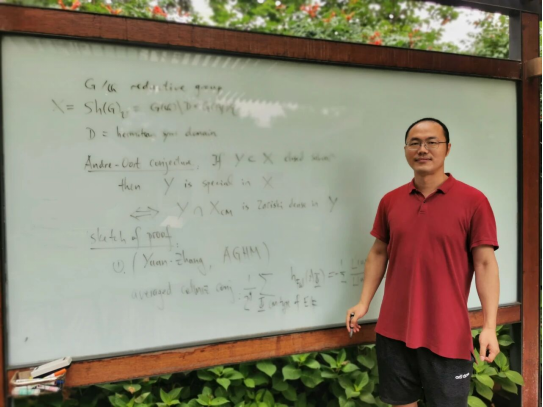
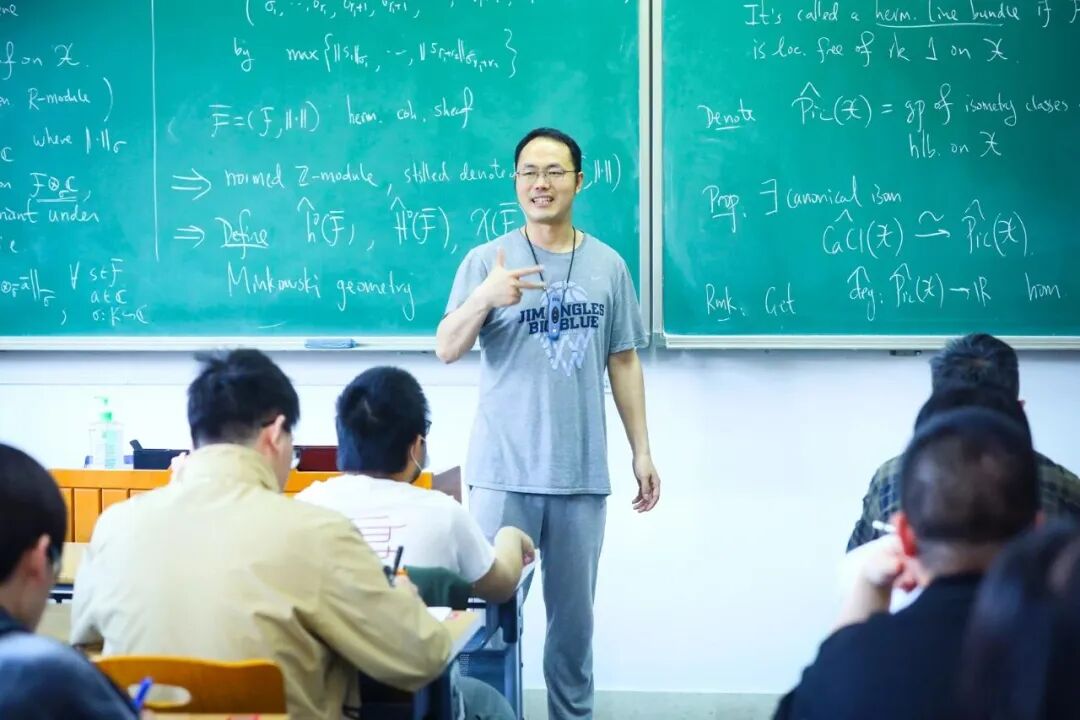
Yuan Xinyi at the International Center for Mathematical Research.
More importantly, he attributes his decision to patriotism. “When I teach here, I believe I am cultivating bright minds for China’s future, which makes me feel more proud.”
In recent years, Yuan has been focusing on the uniform Mordell conjecture, a crucial conjecture in number theory and Diophantine geometry. Last year, he received an invitation to the International Congress of Mathematicians (ICM) 2026 to deliver a 45-minute lecture.
From the days of doubting and dithering, Yuan Xinyi has come a long way. With humility and perseverance as his oars, he has sailed the vast sea of knowledge in a lone skiff, becoming a beacon for future generations.
Written by: Aden Tan
Edited by: Chen Shizhuo
Source: PKU WeChat (
Chinese)