Peking University, April 9, 2026: In a quiet conference room at PKU's School of Earth and Space Sciences, sunlight streams through the window onto Professor Chen Yanjing, a recently elected member of the Chinese Academy of Sciences. With several geological maps laid out on the table, Chen begins with a memory that shaped his life direction.
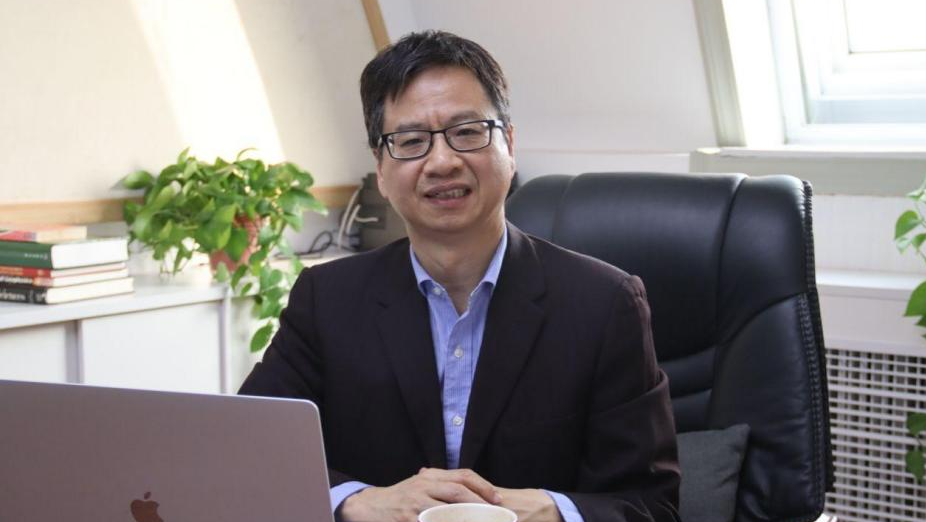
Professor Chen Yanjing in his office at Peking University. [Photo taken by Li Xianghua]
"When I was in high school, our school organized a screening of the film Li Siguang," Chen recalled. "At that moment I felt that geological work—searching for mineral resources for the country—was a truly meaningful career. When I filled out my college entrance examination application, I chose the Department of Geology at Nanjing University."
Chen devoted nearly half a century to geological research, during which he helped Chinese scholars move from participating in international research to contributing original theoretical frameworks. He challenged the long-standing belief that continental collision does not produce mineral deposits and helped establish collision-related metallogenesis as a major research frontier.
Filling the Gap: Bringing the "Chen Model" to Global Textbooks
Chen's research on continental collision metallogenesis began in 1986, when he was assisting with field training for a course in economic geology. While reviewing global metallogenic theories and tectonic models, he noticed that most established frameworks were based on geological environments surrounding the Pacific Ocean, where oceanic plates collide.
These frameworks did not fully explain the geological structure of the Chinese continent, whose landscape was mainly shaped by collisions of continental plates—including the Yangtze, Southeast Asian, and Indian continents with the Eurasian continent.
At the time, however, geologists held that continental collision does not produce mineralization. Proposing otherwise meant challenging widely accepted theory.
Chen's early research therefore faced skepticism. Research proposals were rejected, and some of his ideas were questioned at academic conferences. Nevertheless, he remained determined.
A turning point came in 1996 at the 30th International Geological Congress, where Chen presented a paper proposing a collision-related metallogenic model. The paper was selected as the first keynote presentation in its session and attracted significant attention from international scholars.
In 2009, leading scholars in economic geology formally recognized Chen's CMF Model, which was later included in the international textbook
Hydrothermal Processes and Mineral Systems.
This marked the first time a metallogenic model developed by a Chinese scientist entered the global knowledge system in this field.
"Chinese scientists have never lacked intelligence," Chen reflected. "What we sometimes lack is persistence and confidence."
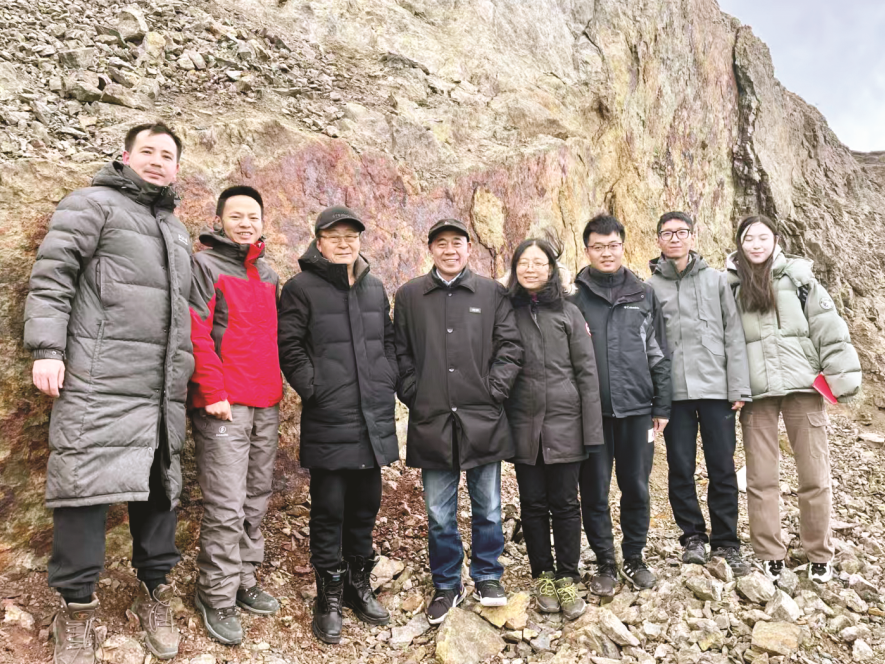
Professor Chen Yanjing (fourth from left) doing fieldwork at the Gezidong gold mine, Xinjiang, December, 2023. [Photo courtesy of Chen Yanjing]
From Theory to Practice: Searching for Minerals for the Nation
For Chen, theory must ultimately serve practice.
Over the years, his research has guided mineral exploration in several regions across China. In western Henan, the number of known gold deposits increased significantly—from only a few in earlier decades to dozens today—making it one of China's important gold-producing areas.
In the Qinling orogenic belt, Chen predicted the metallogenic potential of the Bamudi granite stock, which was later confirmed to have a world-class super-large molybdenum deposit. Other explorations included the Qinghai-Xizang Plateau, Tianshan Mountains, and Sanjiang region.
Yet when asked which discovery brought him the most satisfaction, Chen emphasized not a single deposit but the broader influence of the theory.
"What makes me happiest is that the theory provides a way of thinking for the entire industry," he said. "It helps geologists know where to search, what to search for, and why they can find it."
Chen emphasized the importance of fieldwork. Geological ideas, he believes, must be tested through observation and practical exploration.
"If your theory helps frontline geologists find deposits," he said, "they will naturally recognize its value."
In 2015, continental collision metallogenic theory received the Second Prize of the National Natural Science Award.
Broadening Scientific Vision: Understanding the Earth as an Integrated System
Chen's research extends beyond collision-related metallogenesis.
In the late 1980s, he proposed the idea of a "geological environmental transition event 2.3 billion years ago", which describes a major shift in Earth's atmosphere from oxygen-poor to oxygen-rich conditions.
This idea later provided evidence supporting the International Union of Geological Sciences' definition of the boundary between the Siderian and Rhyacian periods.
Chen explored the relationship between the Great Oxidation Event and the formation of mineral deposits, arguing that rising oxygen levels in Earth's atmosphere changed the geochemical behavior of many elements and influenced mineral formation.
He also proposed interdisciplinary ideas linking mineral systems with energy resources, introducing the concept of "lateral hydrocarbon sources." This theory offers new perspectives for understanding petroleum accumulation in western China.
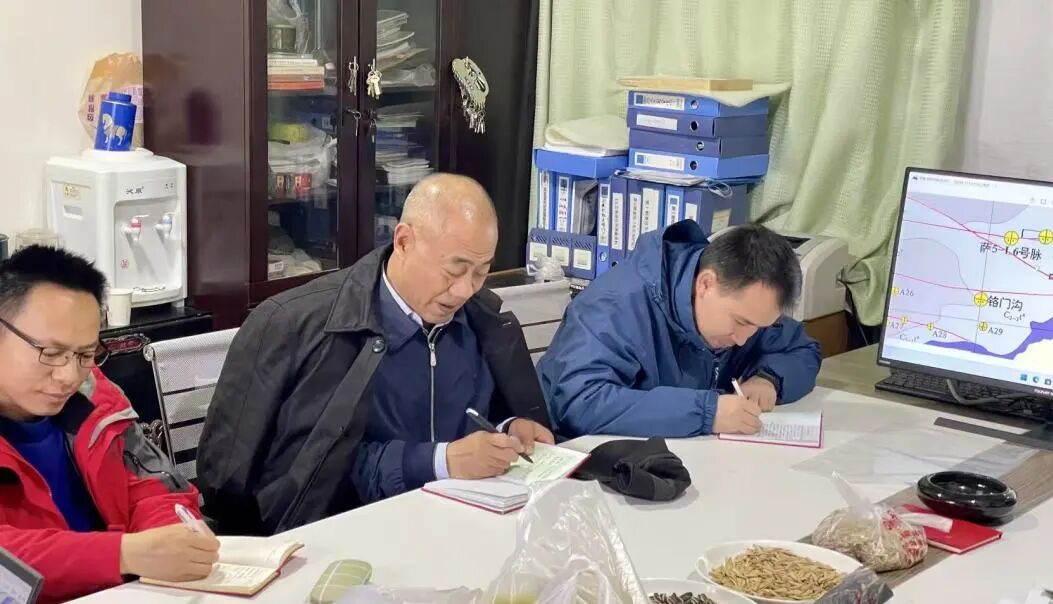
Professor Chen Yanjing in an academic discussion at the Gezidong gold mine, Xinjiang, December, 2023. [Photo courtesy of Chen Yanjing]
A New Chapter as an Academician
For Chen, election to the Chinese Academy of Sciences marks the beginning of a new stage rather than the end of a journey.
"This identity reminds me that I must speak more carefully and responsibly," he said. "But more importantly, it signals a shift in mission."
Chen is now focusing on an even broader scientific challenge: developing a unified framework to explain the formation of hydrothermal mineral deposits worldwide—a problem often described as the "holy grail" of economic geology.
Mentoring younger researchers has become an increasingly important part of his work, and he hopes that young scholars will continue advancing the field.
"Experience tells me that I should gradually move from personal research toward helping younger scholars tackle major scientific challenges," he said.
Looking to the Future: Internationalization Achieved Through Fundamental Breakthroughs
As a PKU professor, Chen reflects on the future of Earth sciences at the university.
"Peking University once pioneered modern geological education in China", he said. "We should continue that tradition."
For Chen, true academic internationalization is not simply about attending conferences.
"Internationalization means producing results that cannot be ignored," he said. "When international textbooks adopt your model, that is real academic influence."
Chen believes universities with strong reputations and resources have a responsibility to contribute lasting scientific achievements.
"Peking University enjoys tremendous social trust," he said. "Its scholars should repay that trust with research that can stand the test of practice and history."
From quiet reflection in his office to shaping ideas of national resource security, Chen Yanjing's work reflects a balance between intellectual curiosity and national responsibility. His research has illuminated both the hidden mineral wealth beneath the Earth's surface and the path forward for future generations of scientists.
Written by: Ashley Leung
Edited by: Chen Shizhuo
Source: PKU News (
Chinese)