Editor’s note: “Southward Journey” is a path of progress brimming with hope and mission. It points to the vast Global South - a land full of vitality and challenges, where the most urgent needs and grandest visions of human development converge. The Institute of South-South Cooperation and Development at Peking University is dedicated to sharing the governance experiences of China and other developing countries, and cultivates high-level government officials for these countries. Batch after batch of graduates from ISSCAD, armed with the knowledge and broadened horizons they gained at Peking University and the deep friendships they forged, have taken up key positions in their home countries or international organizations, and have dove into the front lines of development, becoming the “stars” that illuminate the way forward.
As ISSCAD approaches its tenth anniversary, the National School of Development has organized a dialogue between current students and alumni. Together, they explore the common questions of development, embarking on a deep “co-research” journey that transcends the boundaries between theory and practice, connects local experiences with global perspectives, and integrates the wisdom of young people both at home and abroad.
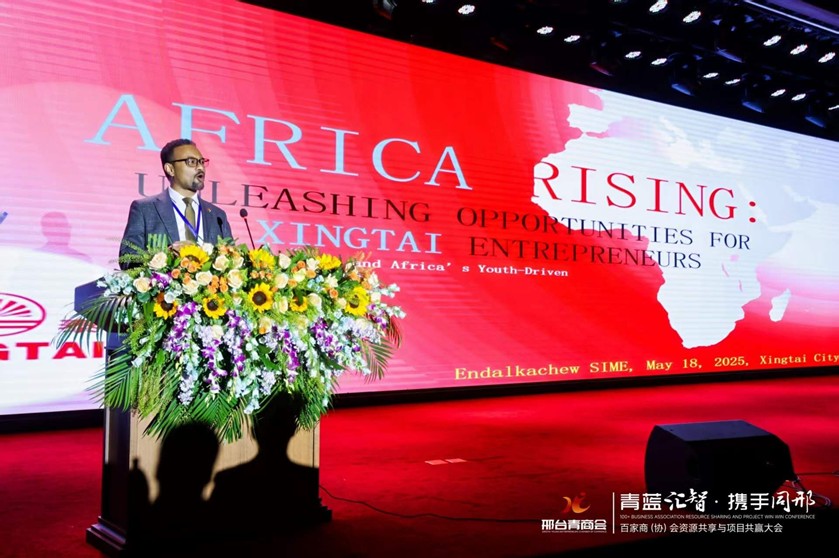
Sime delivering a speech at the Xingtai Youth Chamber of Commerce.
Peking University, April 29, 2026: Endalkachew Sime is a 2025 PhD graduate in Development Economics from the Institute of South-South Cooperation and Development (ISSCAD), Peking University. Hailing from Ethiopia, he brings over two decades of experience in development practice, with a long-standing commitment to industrialization and private sector development. Since 2006, Sime has held a series of key roles, including General Manager of the Ethiopian textile manufacturer Gullele Garment S.C., Secretary-General of the Ethiopian Textile and Garment Manufacturers Association, and Deputy Secretary-General and later Secretary-General of the Ethiopian Chamber of Commerce and Sectoral Associations. In 2019, he served as a Senior Economic Advisor to the Federal Planning and Development Commission at the United Nations Development Program (UNDP). From 2020 to 2022, he was appointed State Minister at the Ethiopian Ministry of Planning and Development, where he oversaw national development program evaluations. In 2022, Sime came to China to pursue his doctoral studies, conducting research under the guidance of Professor Jun Fu on industrial park development in Africa and the challenges of “deindustrialization.” His dissertation earned the First Prize for Outstanding African Studies Dissertation (2025) at Peking University. Following graduation, Sime will return to the Ethiopian government, continuing his work in national policymaking and striving to foster more effective South-South cooperation.
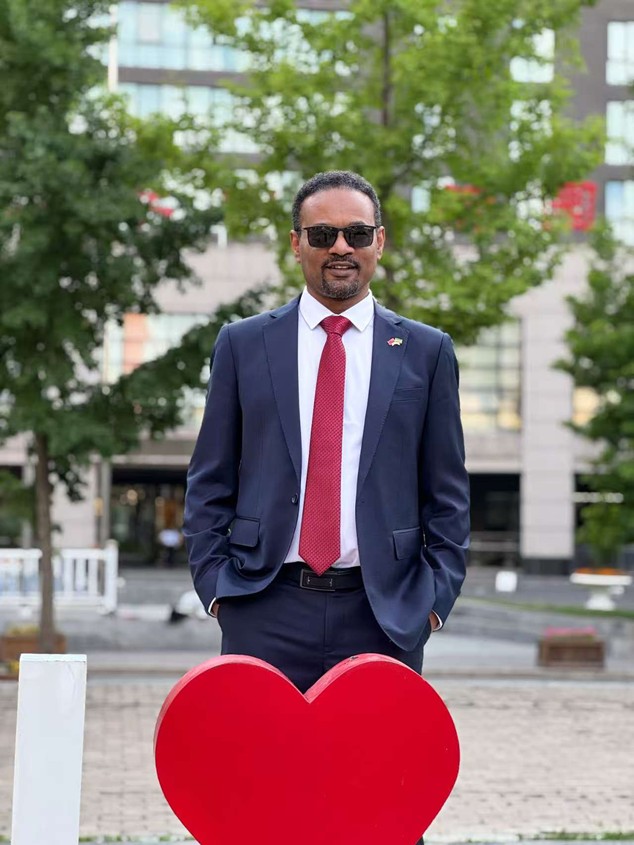
Sime at Peking University
A “Pragmatic Optimist Economist”: Encountering China’s Development Model
When asked to describe himself in one sentence, Sime paused for a moment and replied: “I’m a pragmatic optimist economist.” This concise self-introduction captures the core belief he has upheld throughout more than 20 years of development work. In his view, truly effective reform requires both a pragmatic assessment of reality and unwavering confidence in the future.
Sime’s decision to pursue his Ph.D. in China was no coincidence. Years of working at the intersection of government and industry in Ethiopia gave him a deep understanding of the country’s structural economic challenges, and drove him to search for comparable development pathways. As early as 2004, during his first visit to China, he noticed striking parallels between Ethiopia’s difficulties and the early stages of China’s development. This “years-ahead” resemblance sharpened his interest in China’s development model, especially the New Structural Economics theory proposed by Professor Justin Yifu Lin. “ISSCAD is a gathering place for countries of the Global South,” he remarked, “and the ideal place for me to understand China’s experience and South-South cooperation.” Ultimately, this brought him to Peking University to begin his doctoral journey—a journey of in-depth study and reflection in China.
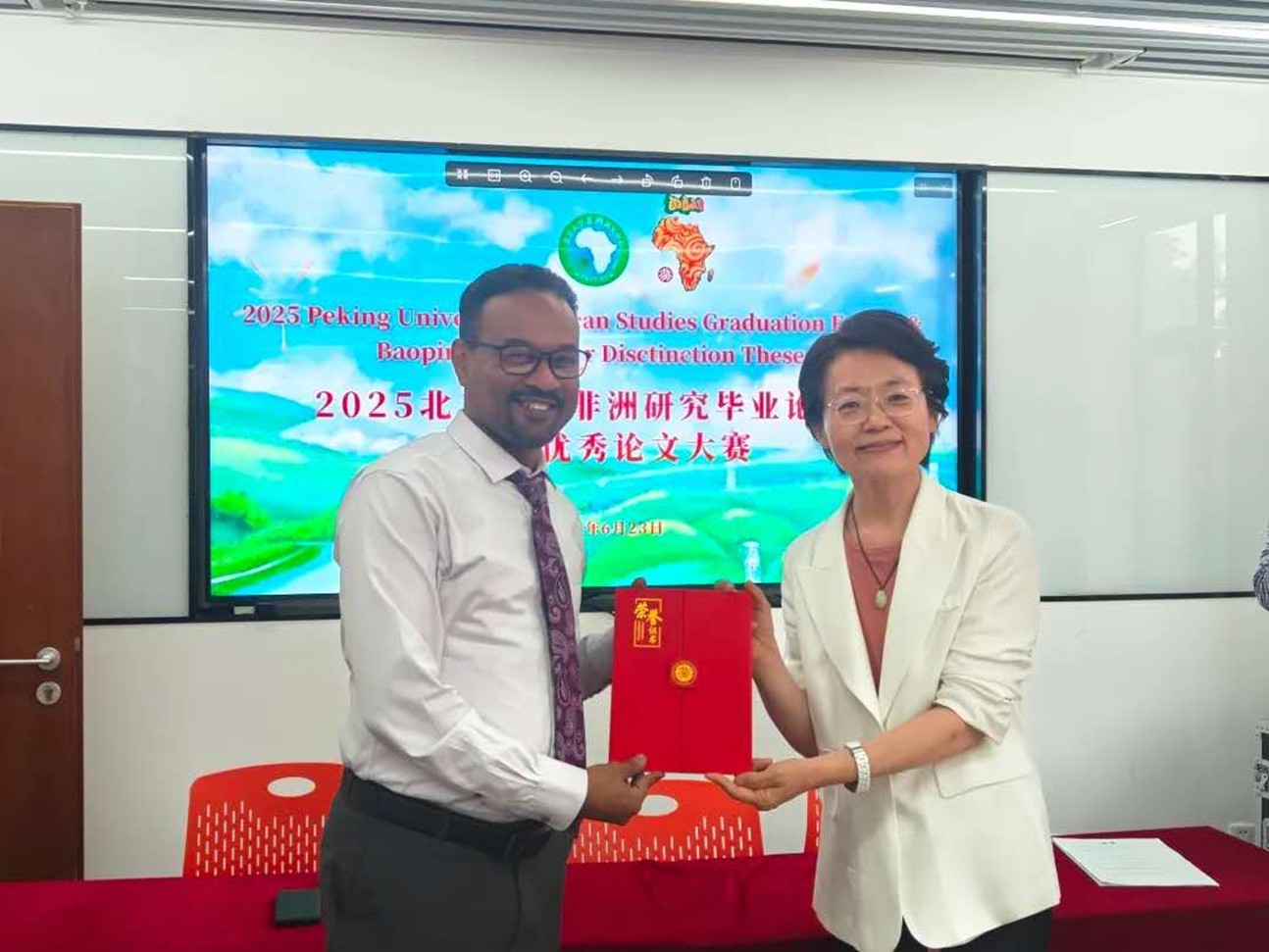
Sime (left) received the First Prize for Outstanding Thesis on African Studies (2025) at Peking University’s Baoping African Studies Awards.
Africa’s Industrialization Dilemma: From Practice to Research
Sime's doctoral research centers on "industrial parks," a focus born from his prolonged engagement with practical development challenges. While Ethiopia's economic growth has consistently outpaced the Sub-Saharan African average in recent years, its industrial sector contributes merely 5% to GDP. To Sime, this presents a paradox: Africa is hardly lacking in industrialization prerequisites—abundant natural resources, vast land availability, a sizable labor force, and in Ethiopia's case, some of the world's lowest industrial electricity fees. Yet the continent exhibits a puzzling trend of deindustrialization.
This contradiction led Sime to investigate industrial parks through a comparative lens, juxtaposing Ethiopia with Vietnam—both nations launched park initiatives around the same period. Today, however, Vietnam boasts over 300 operational parks, with industry constituting nearly one-third of GDP. This stark divergence led Sime to reconceptualize industrial parks: they are not merely infrastructure projects but business ecosystems. “A high-performing industrial park should operate as a tightly coordinated policy arena,” he emphasizes. The key lies in systemic ecosystem design: “From land acquisition and financial services to supply-chain integration—a zipper manufacturer should be next to garment factories, and farmers must have direct linkages with processors.”
During his field research in China, Sime identified several experiences for broader application. In Xi’an, he conducted an in-depth study of the local innovation ecosystem: 15,000 tech companies and 19,000 small and medium-sized enterprises (SMEs) leveraging the China–Europe Railway Express logistics network to achieve collaborative growth. He distilled three key elements that could serve as valuable lessons for Ethiopia’s special economic zone (SEZ) development: close collaboration between universities and research institutes, efficient rail–road connectivity, and value chain integration among SMEs. Beyond the economic sphere, Sime also gained unexpected inspiration. While watching the large-scale performance The Qin Warriors in Xi’an, he was struck by the use of holographic imagery and interactive storytelling on stage—an artistic expression that made him reflect on how national identity can be consolidated and reshaped through cultural narratives. “Just like Ethiopia’s Victory of Adwa,” he said, “a unifying national story and sense of identity can also become policy resources to drive infrastructure development, cultural advancement, and community cohesion.”
As global technology advances rapidly, Sime reflected on a key question: In an era of growing automation and AI, can developing countries still rely on low-cost labor to attract industrial investment? Labor, he emphasized, is not the only comparative advantage for developing nations. “Raw material supply, clean energy, regional market access, and demographic structure still play crucial roles in global value chains,” he explained. While smart manufacturing has accelerated in some countries, he noted that such transformation may still be distant for most African economies. “We still have a window of opportunity to leverage our existing labor force and resources to participate in global manufacturing.” He emphasized that policies must be dynamically adaptive: “Different industries require context-specific technological pathways. Smart factories are not only a threat but also an opportunity—if we can strategically introduce technology and invest in workforce development, Africa still has a chance to strengthen its industrial foundation. The most critical aspect of development policy is continual adjustment and recalibration.”
Priority: Making China-Africa Cooperation More Practical
During his PhD studies in China, Sime remained steadfast in his priority—deepening his understanding of and advancing meaningful, pragmatic, and human-centered China–Africa cooperation. “For me,” he said, “the next focus of my career is to drive collaboration between China and Africa.”
For Sime, South–South cooperation is more than a development theory; it is a lived reality. At the Institute of South–South Cooperation and Development (ISSCAD), he studied and exchanged ideas with peers from over 70 developing countries, actively engaging in classroom discussions on China–Africa development issues, and gaining opportunities to interact directly with leading architects of China’s development experience, such as Professor Justin Yifu Lin. “Equal dialogue among people from developing countries is the most valuable part,” he noted. “Our challenges may arise at different times, but their essence is strikingly similar.” Beyond the classroom, Sime has remained deeply involved in practice. He has published multiple articles in China Daily on Africa’s economy and the prospects for China–Africa cooperation, spoken at numerous conferences, and conducted field research in more than 20 Chinese cities. In Gaomi, Shandong, he observed the use of artificial intelligence in poultry disease control and a smart poultry farming system with an automation rate as high as 98%. This experience inspired him to propose introducing the “Belt and Road” agricultural technology model to Ethiopia. At the 2024 Lucun Forum, he advocated for a community-based approach to eco-tourism. In addition, Sime actively engages in service and leadership roles: he serves as Chair of the African Chapter of the World Rural Tourism Council and as a Senior Advisor at the Institute for International Organization Governance at Renmin University of China.
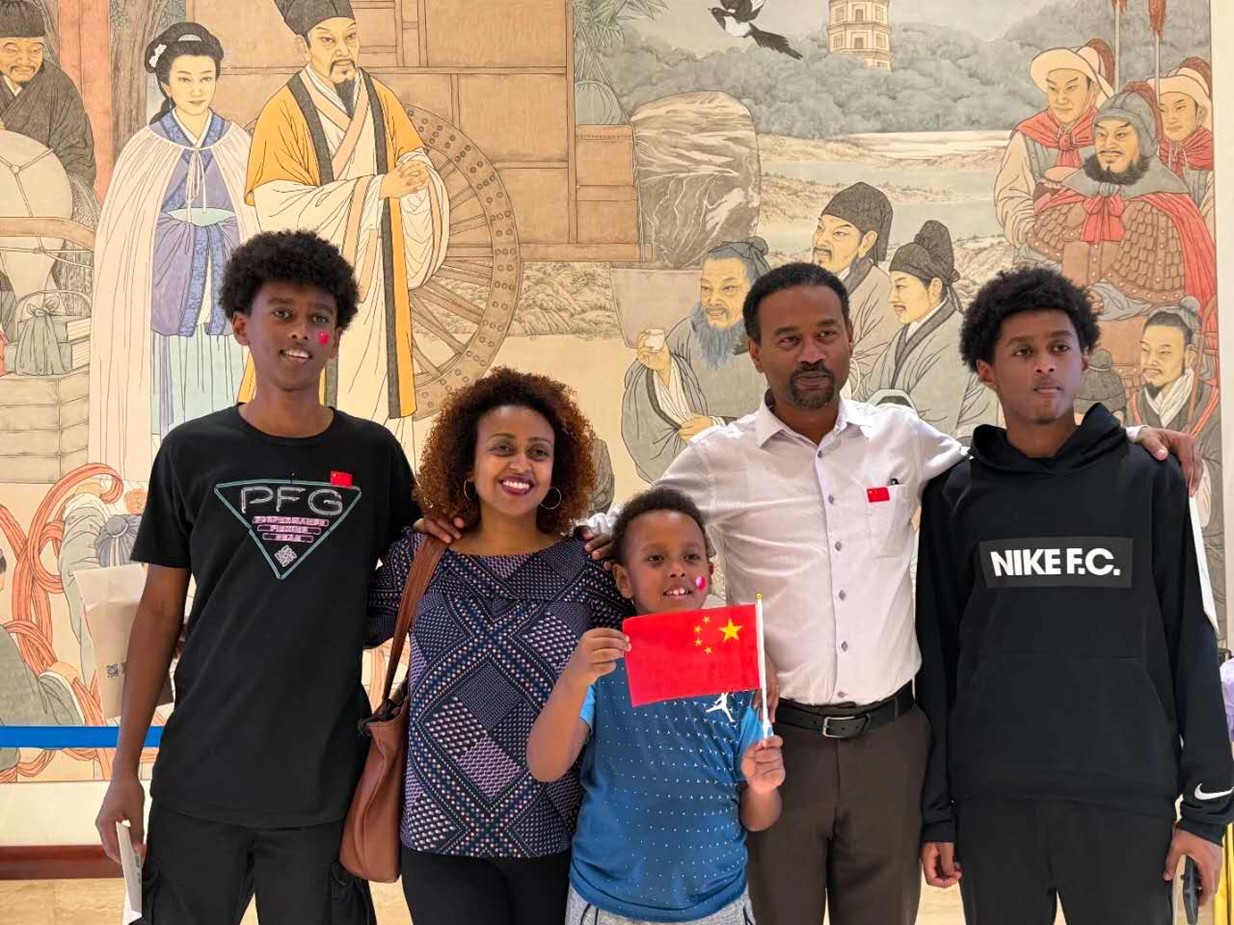
Looking back on his three years in China, Sime said that the most special and memorable decision he made during his PhD was bringing his family to live with him. For him, it was more than just a treasured family experience—it was also a personal way of practicing China–Africa exchange. “I wanted my family to experience China’s development and culture firsthand, just as I have.”
Bringing children across continents to a country with a completely different language and living environment was no easy task. Yet this shared journey of cross-cultural living became a valuable experience of growth for the whole family. “We went through some adventures together, and we’re returning home with new perspectives,” he reflected. Sime also emphasized that mutual understanding between China and Africa cannot rely on empty slogans but must be built through concrete, lived experiences and genuine interactions. He avoids using “cultural differences” as a catch-all for the challenges of cross-national exchange: “What really matters is finding people who share your values and goals. You can’t be friends with everyone, but as long as your direction is clear, you’ll always meet like-minded people.” He added with a smile, “I’ve been lucky to meet many such people in China.”
Sime (second from right) with his family in China.
Advice to Future Students: Come to Co-Create
Reflecting on his three years in China, Sime offered two heartfelt pieces of advice for future African students coming to study there. First, he encouraged them to actively engage in local life—embracing open communication and interaction to deeply experience Chinese culture, enrich their time in China, and broaden their horizons. Second, he urged them to “come with questions and co-create.” He emphasized that the true value of learning lies in whether knowledge and experience can be contextualized and applied back home. “China’s experience cannot be simply copied; we need the ability to ‘translate’ it into the African context,” he said. In his view, meaningful South–South cooperation does not depend on template-based transplantation but on exploration grounded in “comparative thinking” and “practice-oriented approaches”—understanding the experiences of others while responding to the needs of one’s own country, ultimately forging a unique development path.
As a pragmatic optimist, Sime has not only dedicated his doctoral research to examining the challenges of African industrialization but also embodied the essence of South–South cooperation—learning through comparison and advancing through co-creation. His journey demonstrates that the key to development lies in “translation”: transforming China’s experiences into the African context and ensuring policies remain dynamically adaptable to technological change. He hopes that in the future, more students from the Global South will “come with questions and co-create,” building collaborative practices that contribute to the shared rise of the Global South and illuminate a broader vision for human development.
Source: ISSCAD