Editor's note: "Southward Journey" is a path of progress brimming with hope and mission. It points to the vast Global South - a land full of vitality and challenges, where the most urgent needs and grandest visions of human development converge. The Institute of South-South Cooperation and Development at Peking University is dedicated to sharing the governance experiences of China and other developing countries, and cultivates high‑level government officials for these countries. Batch after batch of graduates from ISSCAD, armed with the knowledge and broadened horizons they gained at Peking University and the deep friendships they forged, have taken up key positions in their home countries or international organizations, and have dove into the front lines of development and become the "stars" that illuminate the way forward.
As ISSCAD approaches its tenth anniversary, the National School of Development has organized a dialogue between current students and alumni. Together, they explore the common questions of development, embarking on a deep "co-research" journey that transcends the boundaries between theory and practice, connects local experiences with global perspectives, and integrates the wisdom of young people both at home and abroad.
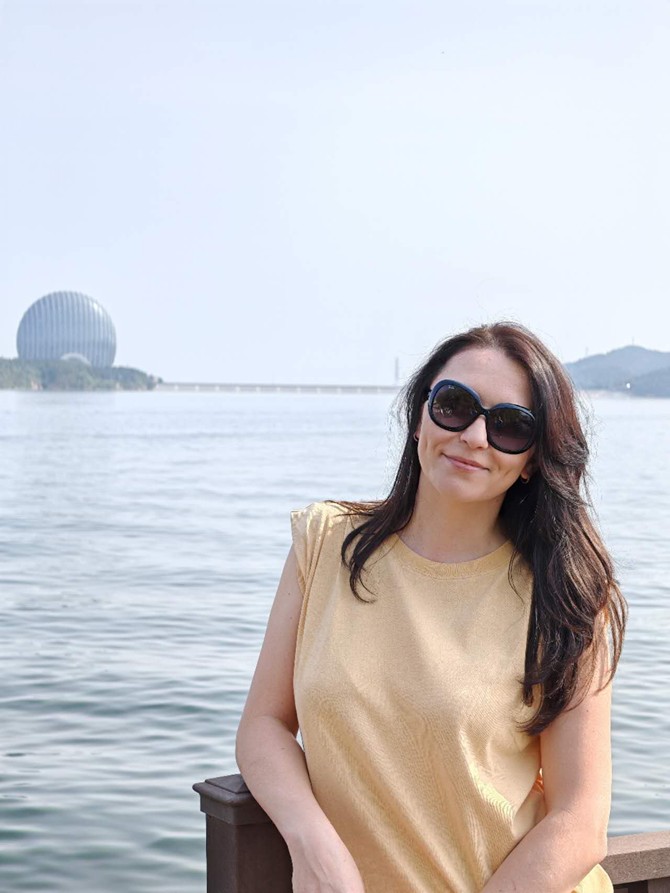
Raluca at Yanqi Lake
Peking University, May 7, 2026: Raluca Boca is a 2025 graduate with a PhD in Theoretical Economics from the Institute of South-South Cooperation and Development (ISSCAD) at Peking University, from Romania. She completed her undergraduate and master's degrees in law in Romania. In 2020, she began a second undergraduate degree in economics in București. In fall 2022, she entered the Institute of South-South Cooperation and Development at Peking University to pursue a PhD in Theoretical Economics. Before entering Peking University, she worked as a tax inspector at the Romanian Ministry of Finance, then transferred to customs work for nearly 6 years, serving in positions including head of the customs department responsible for EU audits. After graduation, Raluca will return to the Romanian customs authorities, committed to transforming academic research into actual momentum for optimizing national trade policies and enhancing economic resilience.
From fiscal management to trade auditing: The Original Aspiration Behind the Path to Economics
Raluca's academic starting point was not economics, but the trajectory from law to economics had early signs. "I once dreamed of becoming a lawyer," she recalls, "but later when I took the bar examination, I was under-prepared and failed to pass." The turning point of fate appeared in the highly competitive National Agency for Fiscal Administration recruitment examination—this exam, involving complex interpretation of fiscal policies and application of legal regulations, actually allowed her to shine. Thanks to the solid foundation laid in law school, she opened the door to the core departments of national governance.
"At work, I began dealing with numbers, which sparked my desire to deeply understand how fiscal policies operate and how economic systems function." The models in textbooks and feedback from reality often have puzzling gaps. When she transferred to customs, responsible for auditing EU trade business, this sense of the gulf between theory and practice became even stronger. It was precisely this gap that drove her to systematically invest in economic research. She deeply realized that relying solely on legal provisions was no longer sufficient to address the complexity of global economic governance. She needed to use economic thinking tools, closely combining these two fields of law and economics, thereby deeply understanding modern national governance and effectively promoting policy formulation.
Raluca's doctoral dissertation topic is deeply rooted in her background and personal observations. Growing up in a primarily agricultural small town, with parents also engaged in planting-related work, she witnessed a puzzling phenomenon: Romania produces abundant raw materials such as grains and livestock, yet data shows the country imports large quantities of similar goods. Even after transitioning from a planned economy to a market economy in 1989, this trade direction remained unchanged. This huge contrast between reality and theory became the core driving force behind her research, also pointing to the deep-level issue of national economic security and economic resilience.
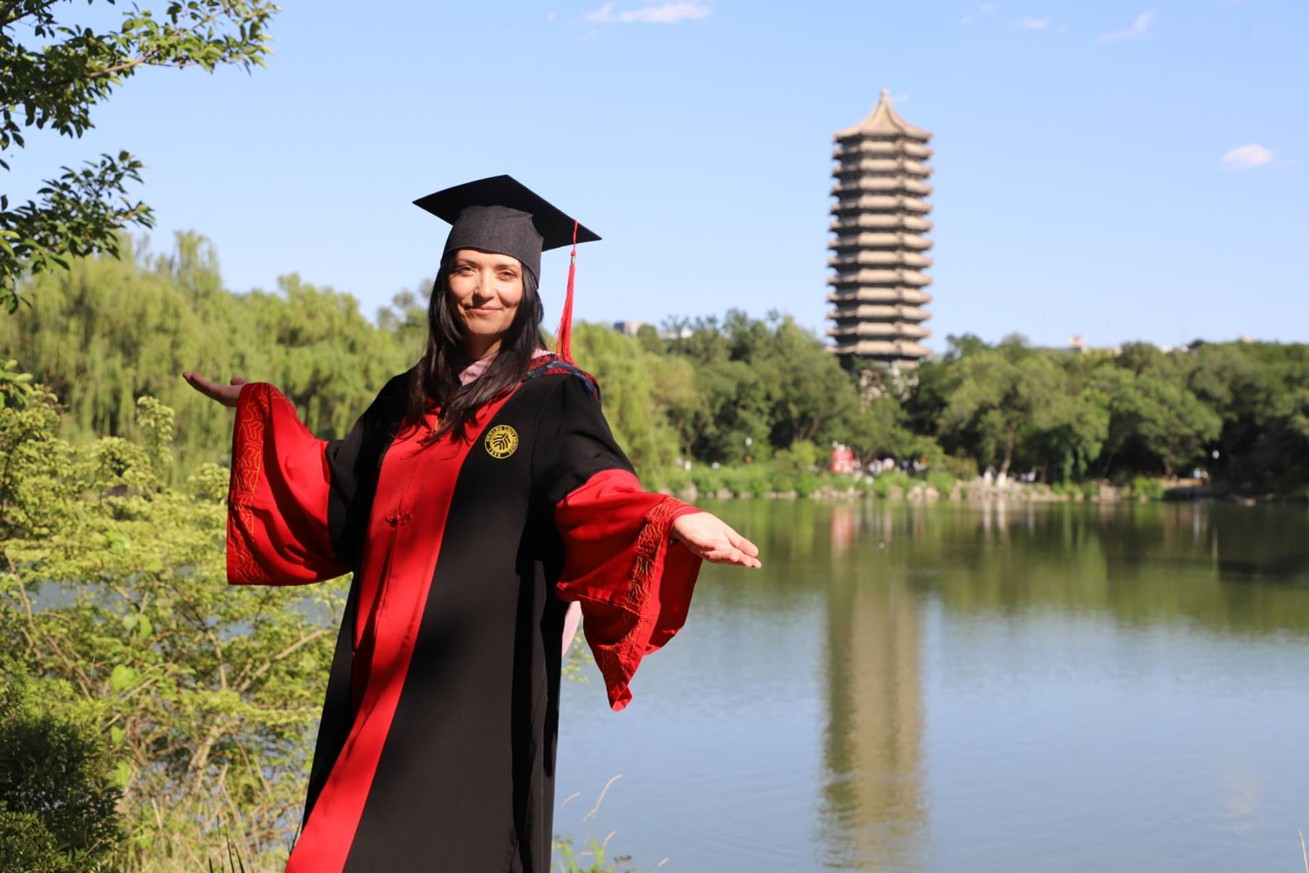
Raluca at Peking University
Under the careful guidance and encouragement of her supervisor Professor Yu Changhua, she transformed this confusion into rigorous academic exploration. She discovered that as one of the EU's major raw material producers, Romania faces serious trade imbalances, which weaken economic resilience. Her doctoral dissertation focuses on the trade paradox of Romania's agri-food sector, adopting an extended international trade gravity model, systematically analyzing various factors affecting Romania's processed agri-food exports, and conducting in-depth analysis of trade data from 2007 to 2023. The research found that the importing country's GDP and per capita GDP, RTAs agreements or common language, have significant effects on Romania's agri-food exports, highlighting the importance of economic factors, trade agreements, and common languages playing prominent roles in international trade.
Raluca innovatively conducted research by subdividing food categories, selecting three specific subcategories of bread, butter, and beef, revealing unique insights different from the overall model: dairy exports significantly benefit from EU membership and regional trade agreements; bread exports grow significantly due to meeting regulatory requirements, particularly A210 food safety standards; beef exports benefit greatly from market access brought by regional trade agreements and standardized norms. Based on this, she proposed specific policy recommendations, including strengthening regional trade agreements, establishing strategic alliances with high-GDP economies, investing in supply chain efficiency and logistics, and using digital tools to overcome language barriers. The research also emphasized the necessity of regulatory coordination, especially in food safety and certification procedures, to improve market access and enhance consumer confidence. This research not only provides important directions for Romania to solve its trade dilemmas, but its methodology and in-depth analysis of trade barriers for transition economies also have great reference value for other developing countries facing similar challenges.
Academics and Family: Balancing and Breaking Through in Dual Identities
Due to the impact of the COVID-19 pandemic, Raluca's first year of doctoral study was completed entirely online. Located in Europe, she had to overcome the time difference, often waking up at two or three in the morning to attend statistics and Chinese courses. But admirably, she never lowered the quality of her learning because of this. She laughed that if she were only 20 years old, she might log into courses and then turn off the camera to continue sleeping. But she deeply realized that learning opportunities are hard-won, and every course or discussion contains important knowledge that might change her thinking dimensions. This reverence for knowledge and cherishing of opportunities supported her through one dawn after another, completing all courses with high quality.
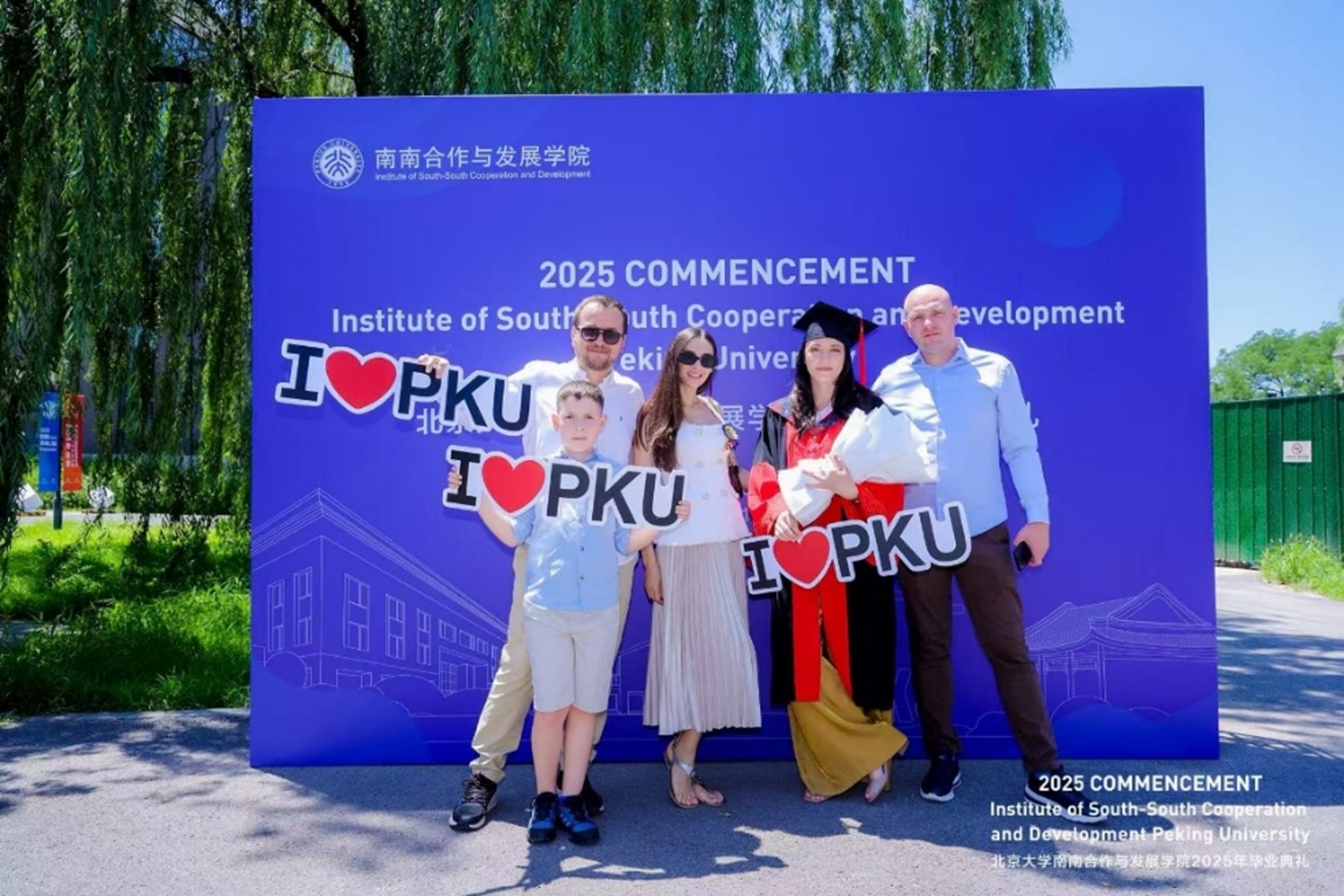
Raluca with her family at ISSCAD
The biggest challenge Raluca faced was how to fulfill her responsibilities as a mother while pursuing a doctoral degree. She gave birth to a young son during her doctoral studies, and the child is currently just over one year old. "Many times, I don't know whether writing a doctoral thesis is harder or raising a child is harder." She frankly admitted that the dual identity brought her enormous pressure. "Leaving my young child in my homeland to be cared for by my mother and going to China alone was extremely difficult for me—it was the biggest challenge I encountered." However, she transformed the challenge into motivation. "For us mothers, children are the source of strength. When the children grow up and become sensible, you will prove to them that everything is possible."
Despite the numerous difficulties, Raluca received tremendous support from the ISSCAD community. During online learning, students located on different continents, facing time differences and network problems together, established a virtual support network of mutual understanding and encouragement. This cross-border camaraderie and support gave her immense warmth and strength. She also attributed the success of her academic journey to her family. During her time in Beijing, her mother proactively took on the responsibility of caring for her young son. It was precisely the whole family's united efforts and joint persistence that enabled her to find that difficult balance point between academic peaks and family responsibilities, ultimately completing a high-quality doctoral dissertation. This extraordinary experience not only fulfilled Raluca's academic dreams but also set a powerful example for her child, vividly demonstrating that learning is a lifelong pursuit, and firm determination and effective action are sufficient to overcome any seemingly insurmountable obstacles.
Open to Everything: Reshaping Understanding of Development and Vision for Romania
The study experience at ISSCAD profoundly reshaped Raluca's understanding of the grand proposition of "development." "This experience made me no longer view development as a linear path, but more like a mosaic pieced together by various strategies under specific contexts. For example, China's work in digitalizing rural areas might somehow connect with Romania's potential in high-end food processing." In-depth exchanges with teachers and classmates, listening to them describe the unique challenges their respective countries face and localized solutions, often brought her sudden enlightenment. When discussing the problems Romania most needs to solve, Raluca believes it is "establishing a clear and positive role pathway for the state in the economy." She advocates that the state should more proactively use economic policies to promote economic structural transformation, establish broader international trade relationships, not limited to EU markets, but going global.
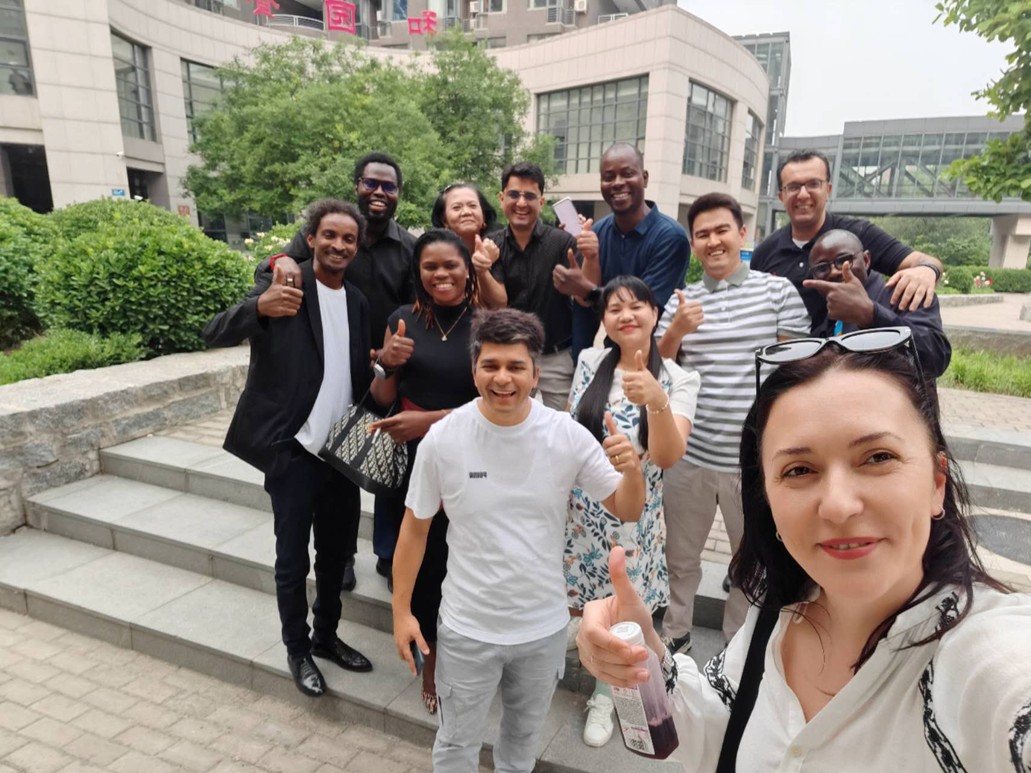
Raluca (first from right) with other international students
She also recognizes that true progress requires academic rigor and the humble attitude of learning from others with an open mind. Actively participating in this learning approach that integrates theory and practice, connecting global perspectives with local concerns, is precisely the core message she hopes to convey to future junior students. "Maintain an open attitude toward every opportunity, even if the process might not be comfortable. Because ISSCAD is not just a program, it is an opportunity that allows you to break through your limits. So, say 'Yes' to all possibilities that come."
Raluca Boca's journey at Yan Garden is a path from a Romanian small town to the halls of knowledge in the Global South, and even more, a practice of continuously "breaking through one's own limits." From crossing over from law to economics, from customs practice to policy research, she deconstructed her hometown's trade paradox with rigorous academic spirit; in the interweaving of dawn online classes and childcare hardships, she demonstrated extraordinary resilience; in the crucible of ISSCAD, she reshaped "development" from an abstract concept into a "mosaic"-style diverse practice. Through her personal experience, she proved that an attitude of "being open to everything" is the key to unlocking potential, and new pathways for national development are embedded in deep insights into local contexts and proactive connections with global wisdom. This "starlight" from Eastern Europe not only illuminated the direction of her journey forward but also lit up hope for more Global South youth who aspire to "break through" their limits.
Interviewed and edited by: Cai Yujie
Source: ISSCAD