Peking University, July 9, 2026: More than a decade ago, a conversation at Peking University (PKU) set the stage for what would become a major breakthrough in understanding one of nature's most familiar yet elusive substances: water.
Wang Enge’s interest in the quantum nature of water dated back to around 2002, when he began to contemplate whether such behavior could ever be directly observed. Nearly a decade later, in early 2010, shortly after Jiang Ying returned to PKU as one of its youngest tenure-track physicists following postdoctoral research in the United States, Wang—then dean of the School of Physics and a leading condensed matter theorist—raised this long-standing question to him. What Wang posed was deceptively simple but scientifically formidable: Could the quantum behavior of water ever be directly observed?
Wang understood that answering this question would demand more than the brilliance of any individual researcher. He therefore set out to assemble an interdisciplinary team spanning condensed matter physics, statistical physics, and physical chemistry. Computational physicist Li Xinzheng, returned from the United Kingdom, brought expertise in path-integral methods. Xu Limei, returned from Japan, contributed her deep understanding of water’s anomalous bulk properties. Theoretical chemist Gao Yiqin, returned from the United States of America, added strength in molecular dynamics simulations, linking atomic-scale processes to complex chemical and biological systems.
Their complementary expertise came together to form a complete scientific chain: Wang and Li established the theoretical framework for understanding the full quantum effects of water; Jiang developed the experimental platform for atomic-scale imaging and manipulation; Xu provided theoretical modeling to interpret the experimental images; and Gao bridged the microscopic discoveries with larger-scale molecular behavior.
The question that brought them together may sound deceptively simple. Water covers more than 70 percent of Earth’s surface, constitutes roughly two-thirds of the human body, and sustains every known form of life. Yet this most familiar of liquids has never behaved like an ordinary one. Ice floats rather than sinks. Liquid water is densest at 4°C and expands upon freezing. Heavy water, despite being chemically almost identical to ordinary water, has distinct melting and boiling points. These long-standing anomalies have puzzled generations of scientists, hinting that one of nature’s simplest molecules harbors unexpectedly rich physics.
In the early 2000s,
Science identified the structure of water as one of 125 major scientific questions for the new century. The deeper researchers looked into water, the more evident it became that its many anomalies were rooted in the structure and dynamics of its hydrogen-bond network.
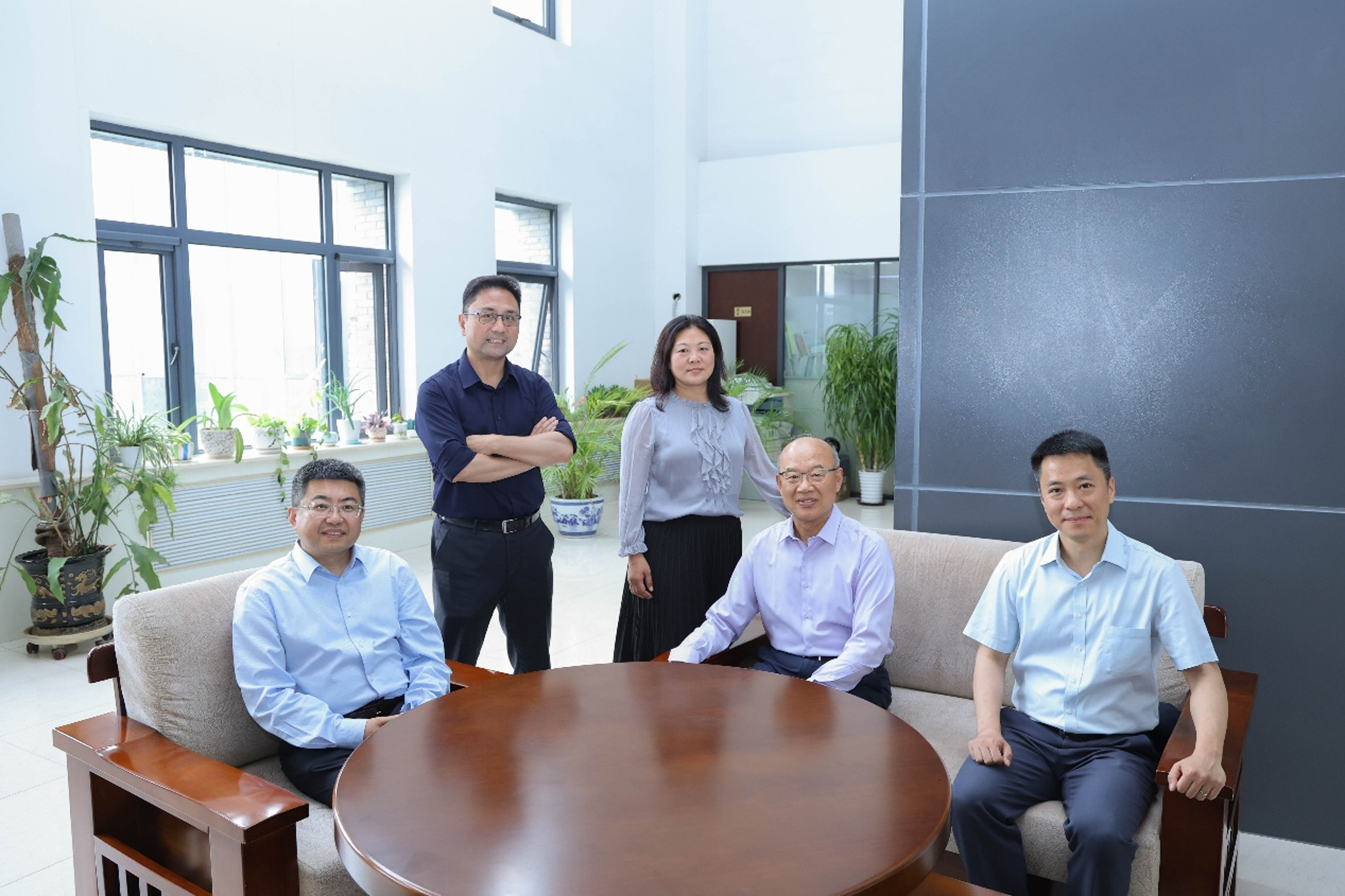
Professor Wang Enge’s team (from left to right: Gao Yiqin, Li Xinzheng, Xu Limei, Enge Wang, Jiang Ying)
Most of us picture water the way we learned it in high school chemistry: a bent molecule made of one oxygen atom and two hydrogen atoms, shown in a simple ball-and-stick model. Yet for most of the past century, that familiar shape was something scientists inferred rather than directly observed. It was reconstructed from spectroscopic measurements and quantum calculations, not seen with the eye of an instrument. Imaging a single water molecule with enough resolution to reveal its internal structure remained beyond reach.
For more than two decades, Wang had pursued a bold idea: the protons in water might not be classical particles sitting still like billiard balls. Like electrons, they might undergo quantum fluctuations and even tunnel through energy barriers that classical particles could never cross. Wang called this the “full quantum effect of water.” Testing the idea seemed almost impossible. It would require scientists to see what no one had seen before: the positions of individual hydrogen atoms—whose signals are notoriously weak—and to measure the subtle quantum effects governing their motion.
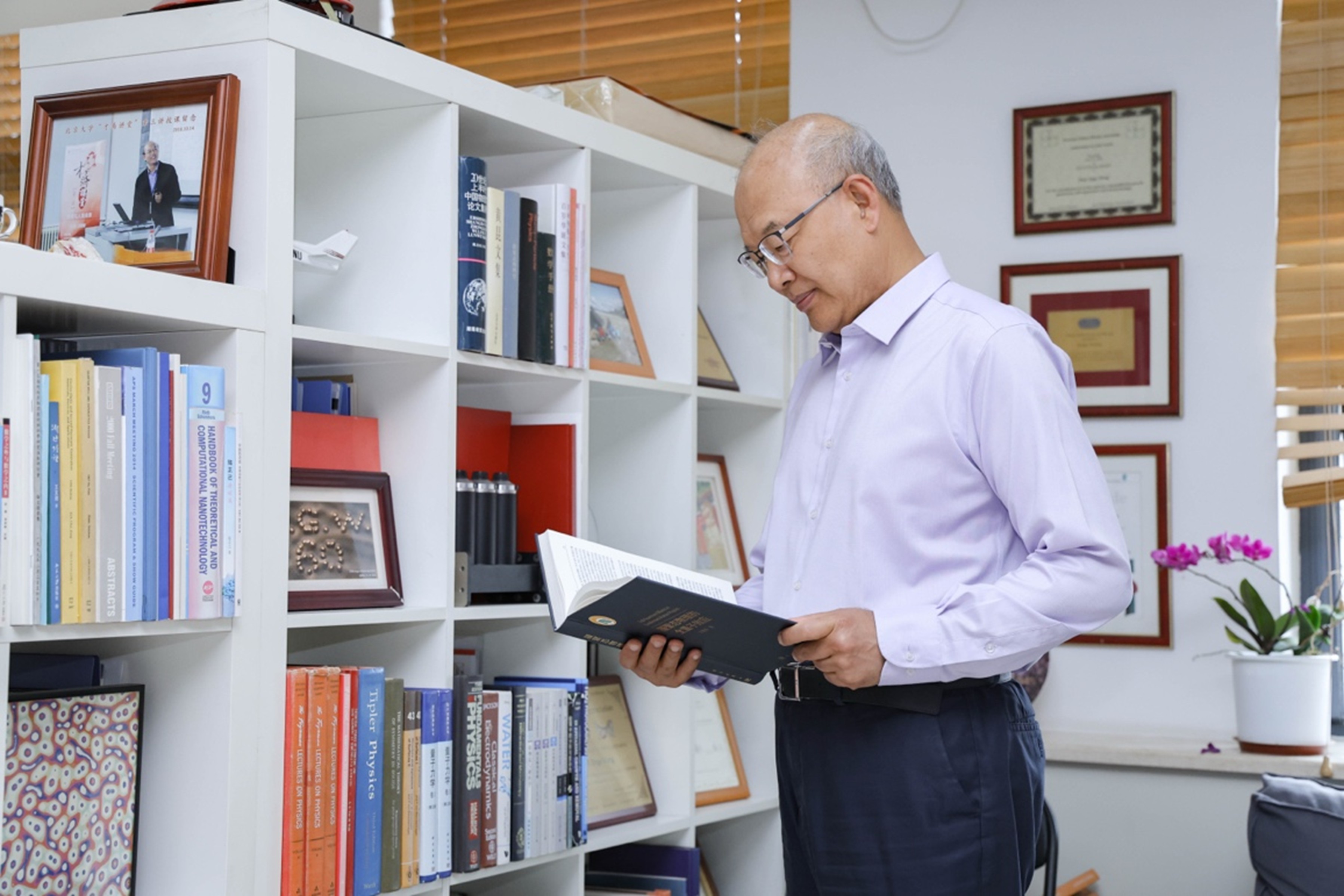
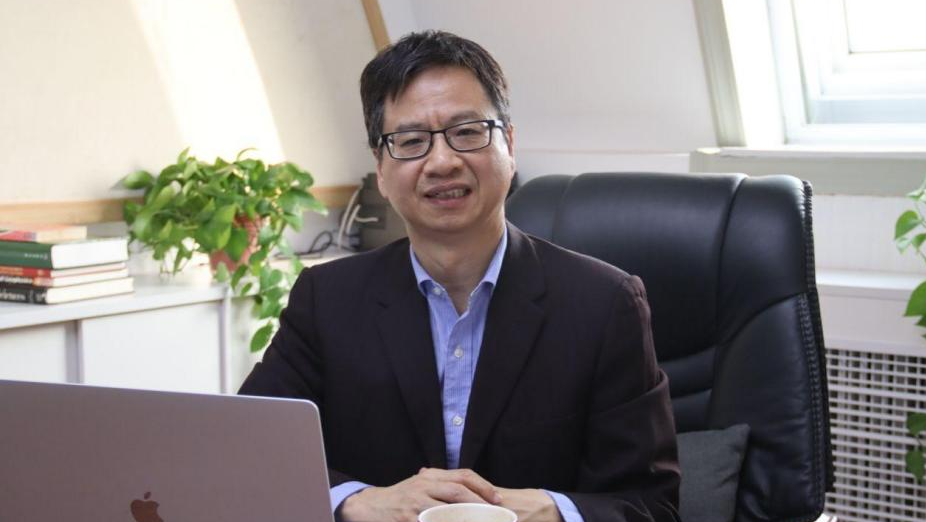
Professor Wang Enge
When Jiang first heard the proposal, he was skeptical. After all, a proton is more than 1,800 times heavier than an electron, and the familiar ball-and-stick picture of molecules encourages us to imagine nuclei as occupying fixed, well-defined positions. The Born–Oppenheimer approximation, while not eliminating nuclear quantum effects, separates electronic and nuclear motion by solving the electronic structure for fixed nuclear configurations. This framework had proved remarkably successful, explaining phenomena ranging from chemical bonding to the quantum behavior of condensed matter. Yet precisely because of its success, the quantum motion of light nuclei—especially hydrogen—was often pushed into the background of how scientists visualized molecular structure.
For nearly a century, few questioned the approximation’s validity. Wang did.
His question was disarmingly simple: if hydrogen nuclei are so light, why should their quantum behavior be neglected? Perhaps this overlooked quantum motion was not a minor correction, but a key to water’s many anomalies. In water’s restless hydrogen-bond network, protons might move collectively in ways that no classical picture could capture. But to prove it, scientists would first have to see hydrogen itself—something no instrument then available could accomplish.
To overcome this challenge, Jiang’s team spent years improving the scanning probe microscope through painstaking trial and error. Their breakthrough came with the development of a special tip carrying a quadrupole charge distribution, which could sense the subtle higher-order electrostatic forces required to locate hydrogen atoms with unprecedented clarity.
In 2014, the team achieved a major breakthrough by capturing the submolecular structure of an individual water molecule, resolving for the first time the precise orientation of its hydrogen atoms. Four years later, they advanced the technique further, imaging the internal structure of a single water molecule and locating its hydrogen atoms in a nearly non-invasive way. This capability also allowed them to visualize hydrogen-bonded water clusters and ion hydrates with atomic resolution.
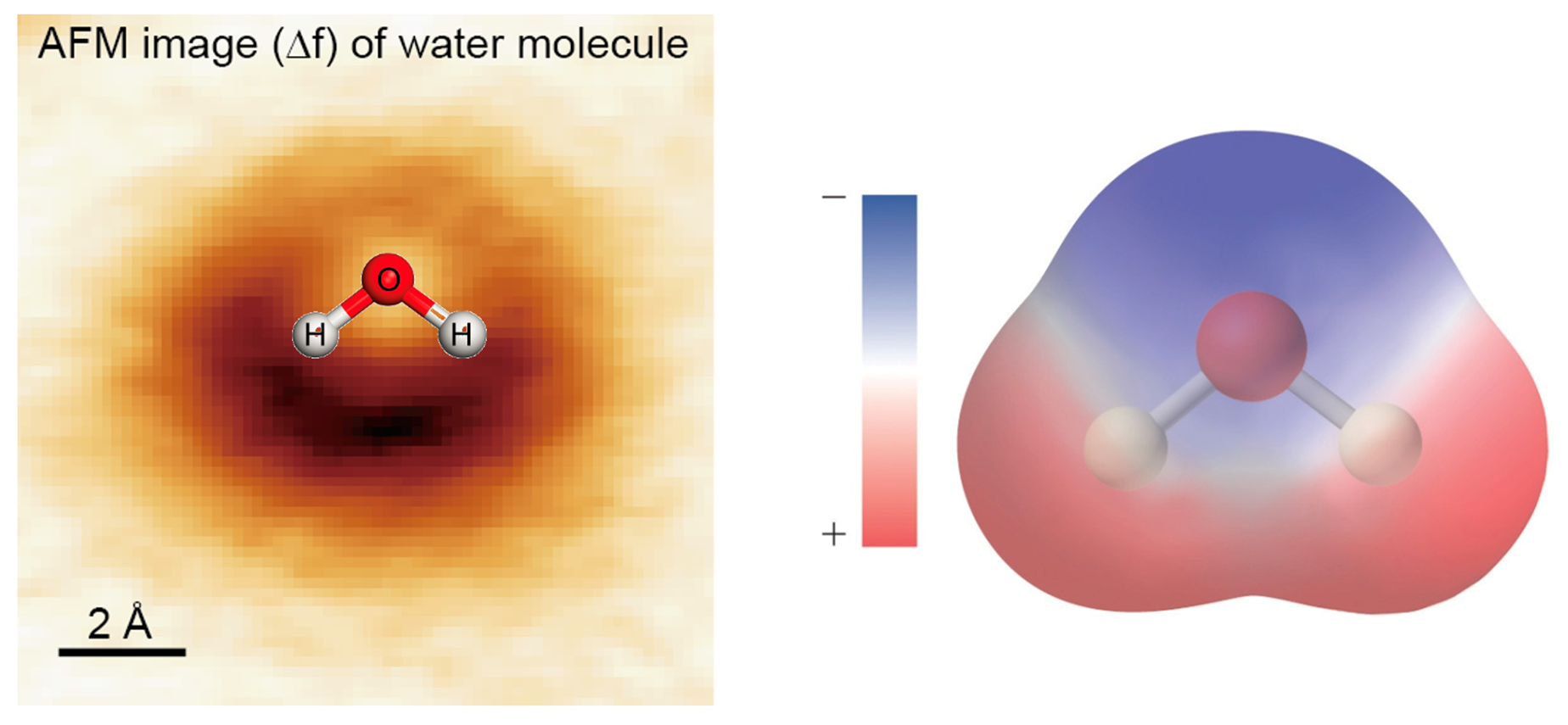
AFM image (left) and electrostatic potential distribution (right) of a water molecule
The work did not receive universal acclaim at first. Instead, it was met with fierce skepticism. Some of the world’s leading experts argued that the striking images could not possibly be real hydrogen atoms. What Jiang’s team saw, they claimed, were merely “ghost signals”—artifacts produced by a mechanically flexible microscope tip, creating deceptive patterns rather than revealing genuine atomic structure. To many in the field, the images seemed simply too good to be true.
But careful comparisons between experiment and simulation changed the picture. In a definitive 2018 publication, the team laid the skepticism to rest: the signals were not ghosts, but the true faces of hydrogen atoms.
Armed with a validated instrument and supported by full quantum simulations, the team went on to make a series of breakthroughs over the following decade. In 2016, they published a landmark study in
Science, reporting the first quantitative measurement of nuclear quantum effects in water. The work showed that the quantum behavior of atomic nuclei was not a minor correction: its contribution to hydrogen bonding exceeded the energy scale of thermal motion at room temperature.
In other words, the anomalies of water cannot be fully explained without taking seriously the quantum nature of its hydrogen nuclei. Around the same time, the team uncovered direct evidence for concerted proton quantum tunneling. Even at temperatures approaching absolute zero—where atoms might be expected to sit nearly frozen in place—hydrogen nuclei were found to tunnel collectively through the hydrogen-bond network. This collective proton transfer in a realistic system goes beyond the classical Grotthuss mechanism proposed more than 200 years ago, and its theoretical description requires the path-integral formulation of quantum mechanics.
In 2018, the team reported another first in
Nature: the atomic-resolution real-space imaging of hydrated ions. Although hydrated ions had been a familiar concept for more than a century, no one had directly observed their atomic structures. The images revealed how water molecules arrange themselves around individual ions and exposed an unexpected magic-number effect: sodium ions coordinated by three water molecules moved across a sodium chloride surface one to two orders of magnitude faster than other hydrated clusters. Molecular dynamics simulations traced this extraordinary mobility to a symmetry match between the hydrated ion and the underlying crystal lattice.
By 2022, the team had progressed from observing nuclear quantum effects to manipulating them. Seeking to amplify these effects, they developed a way to dope individual protons into water’s hydrogen-bond network—an approach reminiscent of electron doping in semiconductors. Using this strategy, they assembled a novel two-dimensional form of ice that violates the so-called “ice rule,” a result reported in
Science.
In 2026, these breakthroughs culminated in the team receiving China’s State Natural Science Award First Prize, one of the nation’s most prestigious honors in the natural sciences. The award is widely regarded as China’s highest recognition for fundamental research and is reserved for scientists who have made major original discoveries.
The selection process has been known for its rigor. Research must be previously undiscovered by the international community, carry substantial scientific value, and receive broad domestic and international recognition. Wang Enge’s team brought the honor to PKU with their work on
Nuclear Quantum Effects on Hydrogen-Bond and Dynamics of Water.
Today, their proprietary imaging instrument has been fully commercialized, reducing reliance on imported high-end scanning probe microscopes.
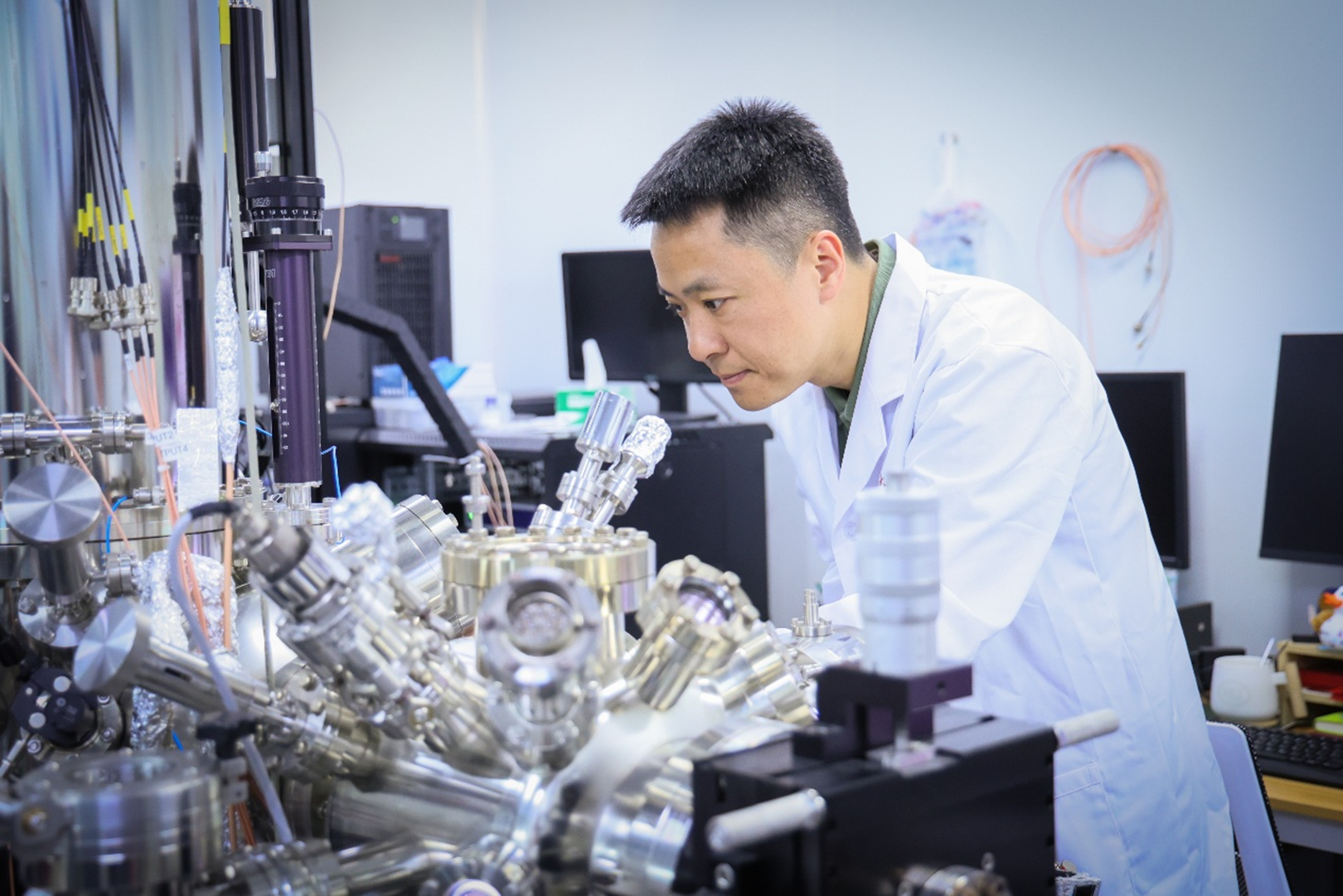
Jiang’s proprietary imaging instrument has been fully commercialized
The five core members came from different fields and were not very familiar with one another at the beginning. The students played an important role in bringing the team together. At that time, the project was still small enough for several research groups to hold regular joint meetings. Some students worked at the boundary between theory and experiment, while others were co-supervised by different advisors. By moving between groups and joining different discussions, they gradually helped connect the researchers into a single team.
When questions arose, students would usually begin by consulting their own supervisors. If a problem extended beyond one advisor’s expertise, they would seek input from other relevant groups. Over time, students moved across seminars, research teams, and disciplinary boundaries, gradually becoming the connective tissue that held the collaboration together.
Under Wang Enge’s coordination, the team gradually developed into an integrated yet flexible collaboration. Expertise was directed to the problems where it was most needed, and different strengths were brought together as new challenges emerged. Through continuous interaction among students and researchers, the group built both strong cohesion and the ability to adapt.
Like water itself, the team was formed not by rigid structure, but by movement. It flowed across disciplinary boundaries, gathered different perspectives, and adapted to each new challenge in real time. Ideas and contributions circulated freely, sustaining a shared momentum of exchange, refinement, and discovery at the frontiers of knowledge.
Looking back, it is tempting to describe the story simply: a question about water persisted for years and eventually led to a series of breakthroughs. But the roots of this achievement reach much further back. What connects these efforts is not haste, but steady and deliberate accumulation.
To understand a single drop of water, it took them nearly twenty years. Yet even that drop contains the strange character of water itself—ordinary in appearance, but full of anomalies in its behavior. Beyond it still lies a vast, unexplored wilderness of natural wonders. Generations after generations, like rivers joining rivers, the work continues—flowing forward, deeper and further.
Written by: Wu You, Wong Jun Heng
Edited by: Chen Shizhuo
Photo by: Li Xianghua, Liu Yan