Editor's note: Nine Peking University professors and associate professors have been announced as the winners of this year's Peking University Teaching Award, which is an annual award that recognizes outstanding educators in the school. The award comprises two categories: the Teaching Achievement Award and the Teaching Excellence Award, and is befittingly announced each year on September 10, the Teacher's Day in China. In this series, we celebrate these distinguished teachers by sharing their unique methods on cultivating bright minds and views on the future of education.
Peking University, October 2, 2026: Chen Xingliang first stepped into the campus of Peking University just as frost was giving way to blossoms in early 1978, his optimism edged with a sense of desolation. He was among the first cohort of college students after the college entrance examination was restored, but now he was at a loss again, not knowing what to study, harboring only a nascent interest in Western philosophy.

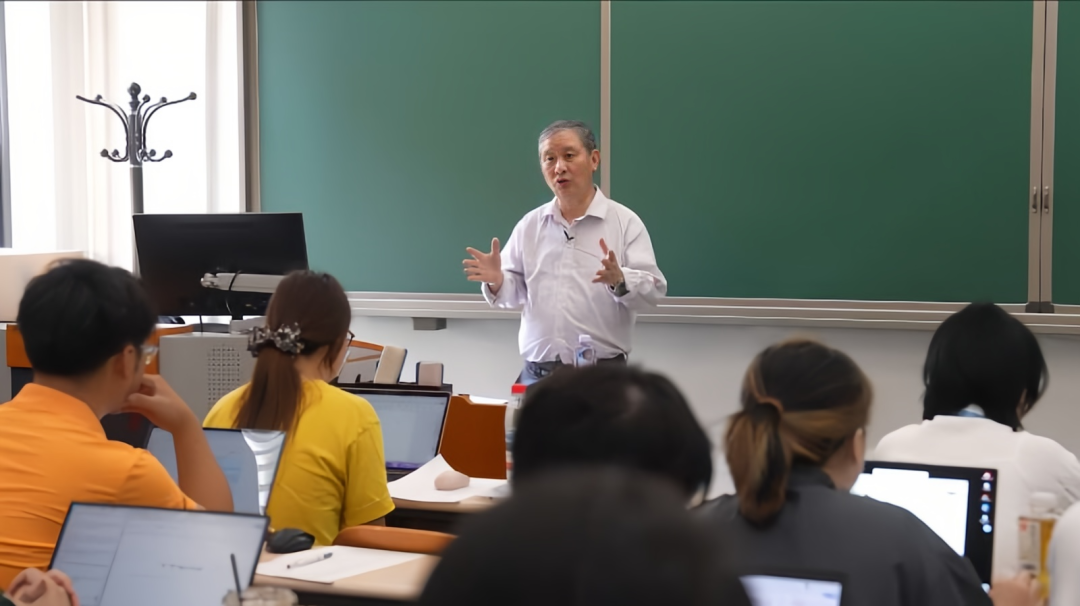
Professor Chen Xingliang
The study of law was a niche area at the time, and Chen never imagined that he would later build a long academic career in law, much less win the 2026 Peking University Teaching Achievement Award, after 28 years of teaching.
This is one of the highest honors for educators at the school, in recognition of enduring dedication to the lectern, high quality of teaching, and major breakthroughs in research. Winners are often the most senior professors.
Reflecting on this honor, Chen credits his cherished mentors with leading him onto the right path. “I have always modeled myself after my mentors, and I believe learning from them is the best way to pass on their legacy.”
Chen put philosophy as his first choice of major when applying for PKU, but was admitted to the Law School instead, which was only his third choice. There weren’t many law books yet, so he immersed himself in reading Western philosophy, which he now credits with building the foundation for his law research.
During his undergraduate study, it was Prof. Zhang Guohua—a pioneer in law and history studies—who introduced him to the history of Chinese law and philosophy, making up a serious blind spot in Chen’s knowledge system, since he only had limited knowledge in Chinese history.
Zhang revealed to him the progress of law and legislation in China over more than 2,000 years, vividly portraying the seminal figures such as Confucius, Laozi, Shang Yang, and Han Fei. But Chen also remembers him for his humorous style of teaching, recalling a time when Zhang saw a student walking on a byway outside the classroom and rattled off the phrase “Xing Bu You Jing,” setting the room in an uproar. He later found out that the phrase came from
The Analects, meaning one shouldn’t cut corners.
The four years of Chen’s undergraduate study can be characterized as broad reading and foundation building. After beginning his graduate study at Renmin University of China in 1982, his focus narrowed, and his research deepened.
Still, his mentors played a key role in shaping his research trajectory. He highlights two mentors in particular: Wang Zuofu and Gao Mingxuan, who guided him during his graduate and doctoral studies respectively.
Chen Xingliang (first from left), Wang Zuofu (third from left), and Gao Mingxuan (third from right) in a photo taken in September, 1986.
From Gao’s methodology of synthesis, Chen learned to analyze cases from a bird’s eye view and quickly obtained a firm grasp of a range of topics and points of contention in criminal law. He and three other classmates together helped Gao edit a book summarizing the criminal law study in China from 1949 to 1985. This book was published in 1986 and was the first of its kind, paving the way for similar jurisprudential overviews—in civil law, theory of law, etc.— to follow.
Where Gao took a holistic and theoretical approach to analysis, Wang was more focused on the practical side and proceeded on a case-by-case basis. According to Chen, Wang once emphasized to him that unlike prose or philosophical arguments, which were intended to inspire awe and contemplation, legal documents should be more like instruction manuals and provide clear guidance for action.
Though the two mentors differed in direction, they had a combined effect that informed Chen’s realization that law study should serve the practical needs of society instead of obsessing with high-flown ideologies. This revelation was reflected in his dissertations for his graduate and doctoral degrees, focusing respectively on justifiable defense and criminal complicity. Both writings address specific stipulations in criminal law and cater to judicial practices, cementing Chen’s status in criminal law study in China.
Practicality is now a running theme in Chen’s classes at PKU. He often asks students to analyze real cases as homework and to base their arguments on the theories they’ve learned in class, which allows him to assess students’ understanding while also improving their analytical writing skills.
This approach proved so successful that he edited select case analyses by students of the 2005 cohort into a book and published it in 2008 with China Renmin University Press. The book was later included on the publishing house’s recommended reading list for law students.
Professor Chen Xingliang
But a truly deep comprehension of law, Chen says, is underpinned by an extensive education in the liberal arts.
When asked whether he is concerned about students being confined in their thinking when studying law, Chen argues that law study should never be limited to rote memorization of legal text. Undergraduate students, in his opinion, should dip into a wide variety of liberal arts disciplines such as sociology, political science, philosophy, economics, and the humanities, which can build a foundational understanding of societal workings and human behavior.
To illustrate his point, he compares the study of law with the study of medicine. An overall understanding of human physiology might not help a doctor prescribe drugs to a patient in every case, he argues, but it is the foundational knowledge upon which the edifice of the medical profession is established.
Similarly, a nuanced understanding of human behavior and psychology can help with legal analyses when they are entangled with ethical considerations. Thus, Chen reasons that plunging into law study head-on is not a smart choice for undergraduate students.
To put his vision into practice, for example, he once played movies for his undergraduate students in 2005 when they were on the topic of death penalty. The movies included
The Wizard of Oz,
The Shawshank Redemption,
To Kill a Mockingbird, and
Keiho (a Japanese courtroom drama). He says the movies can help students understand the social circumstances and personal beliefs behind people’s decisions, besides pure law.
“Instead of rigidly reciting the textbook, law professors for undergraduate students should use a variety of methods to stimulate the students’ interest and curiosity.”
Interest, indeed, is the main driving force behind Chen’s prolific publications. His
Research on Criminal Law contains 13 volumes and 6.81 million Chinese characters, the culmination of all his research from 1984 to 2020. This collection won the China Publishing Government Award this year.
Chen Xingliang’s ‘Research on Criminal Law’ contains 13 volumes and 6.81 million Chinese characters.
He attributes such a colossal accomplishment to a simple habit of writing something every day. “Writing has become a part of my life, and I will panic if I stop writing for a couple of days,” he says. “Once you’ve honed your writing skills, and you’ve read some books and done thinking, it would be natural to pick up a pen and dash off an article.”
Connecting the topic to contemporary students, he observes that most of them choose majors based on utilitarian considerations—such as employment outlook and score in the college entrance examination—instead of their own interest. In this case, he believes, the onus falls on the teacher to kindle the students’ thirst for knowledge.
Written by: Leow Kai Lim
Edited by: Chen Shizhuo
Photo by: courtesy of Chen Xingliang