 Peking University, November 28, 2025
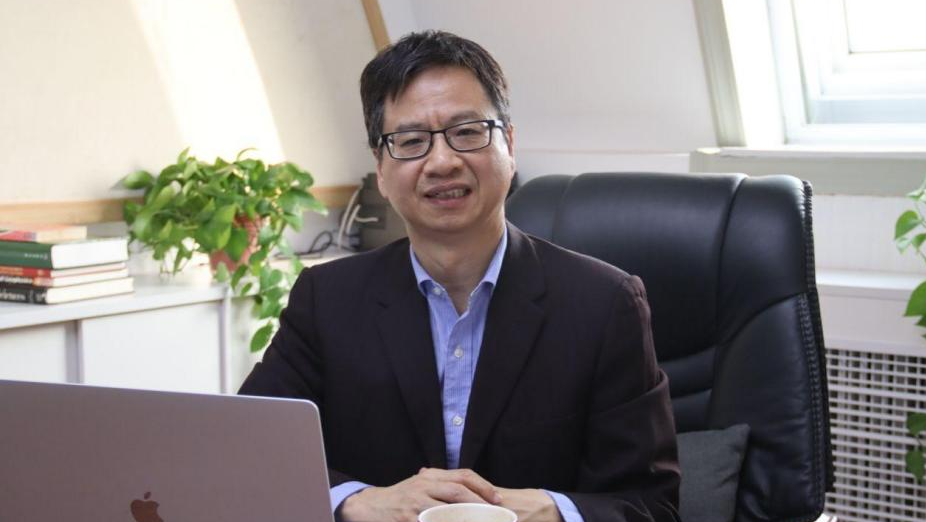
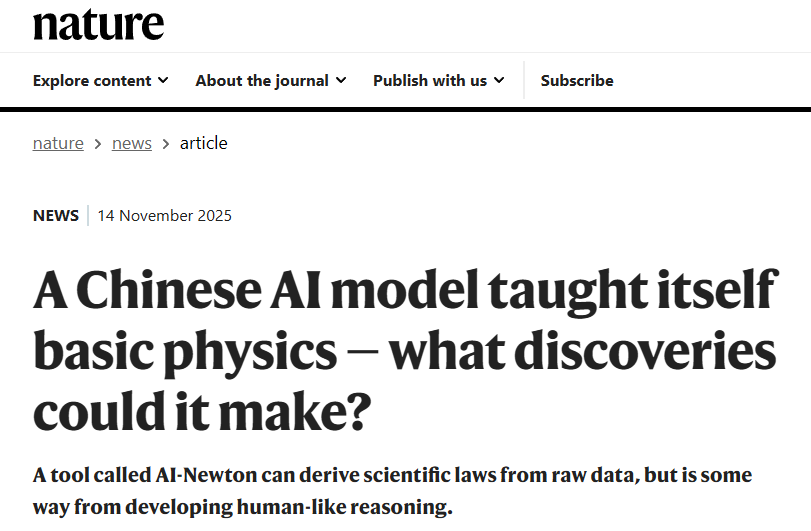
: A significant step forward in AI-driven scientific discovery has been made by a research team led by Professor Ma Yanqing at the School of Physics. They have developed AI-Newton, an artificial-intelligence (AI) system capable of autonomously discovering fundamental physics laws from experimental data. The work was featured in a news article by the journal
Nature.
 Background
Current AI models excel at recognizing patterns in data and making predictions but typically struggle to use that data to come up with broad scientific concepts. For example, an AI model can be trained to accurately predict planetary orbits but cannot derive the laws of gravity on its own. Humans are still needed to interpret equations and distill raw data into a general law.
Why It Matters
AI-Newton mimics the human scientific process by incrementally building a knowledge base of concepts and laws. This ability to identify useful concepts means that the system can potentially discover scientific insights without human pre-programming.
Key Findings
The innovation of AI-Newton lies in the fact that rather than accomplishing the task in a single step, it mimics the cognitive process of human scientists by progressively building a knowledge base of concepts and laws. It uses an approach called symbolic regression, in which the model hunts for the best mathematical equation to represent physical phenomena. And this ability was borne out through 46 physics experiments.
For example, AI-Newton was given data on the position of a ball at a given time and asked to come up with a mathematical equation that explains the relationship between the two variables of time and position. It was able to provide an equation for velocity, and then stored this knowledge for the next set of tasks, in which it successfully derived the mass of the ball using Newton’s second law.
Future Implication
This technique is a promising method for scientific discovery because the system is programmed in a way that encourages it to deduce concepts. Moreover, Ma thinks their work can help to train future AIs to use real-world data to discover new general laws of physics. His team is now testing whether the model can uncover quantum theories.
*This article is featured in PKU News "Why It Matters" series. More from this series.
Read more: https://www.nature.com/articles/d41586-025-03659-4
Written by: Han Yuge
Edited by: Sean Tan, Chen Shizhuo
Source: PKU News (
Chinese)