 Peking University, Mar 3, 2026
: Why did atmospheric methane rise at an unprecedented rate during 2020–2022, intensifying global warming at a critical time for climate action? A research team led by Professor Peng Shushi from the College of Urban and Environmental Sciences at Peking University (PKU), in collaboration with international partners, has identified the key mechanisms behind this dramatic surge. By combining satellite data, ground observations, and advanced models, the team showed that a temporary weakening of methane removal, together with climate-driven increases in natural emissions, drove the surge. Their findings were published in Science.
Background
Methane (CH₄) is the second most important greenhouse gas after carbon dioxide (CO₂) and has more than 80 times the warming power of CO₂ over 20 years. Between 2019 and 2023, atmospheric methane increased by about 55 parts per billion (ppb), reaching a record 1921 ppb in 2023, with growth rate peaking in 2021. Scientists have debated whether this spike was caused by rising emissions or weakened atmospheric removal.
Why it matters
Methane accounts for roughly one-third of current contribution to global warming and exerts a powerful short-term climate effect. Understanding the drivers of this surge is critical for effective mitigation and for meeting international climate commitments.
Key Findings
The study found that atmospheric hydroxyl (OH) radicals, the primary oxidant responsible for removing methane, declined sharply during 2020–2021. This temporary weakening of the methane sink explains roughly 80 percent of the year-to-year variability in methane growth between 2019 and 2023. Reduced nitrogen oxide (NOₓ) emissions during the COVID-19 period contributed to lower OH levels, allowing methane to accumulate more rapidly. At the same time, an extended La Niña event from 2020 to 2023 brought wetter-than-average conditions across tropical regions. Expanded wetlands and inland waters in tropical Africa and Southeast Asia, along with increased emissions from Arctic wetlands and lakes, significantly boosted microbial methane production. Fossil fuel and wildfire emissions played only a minor role in the surge.
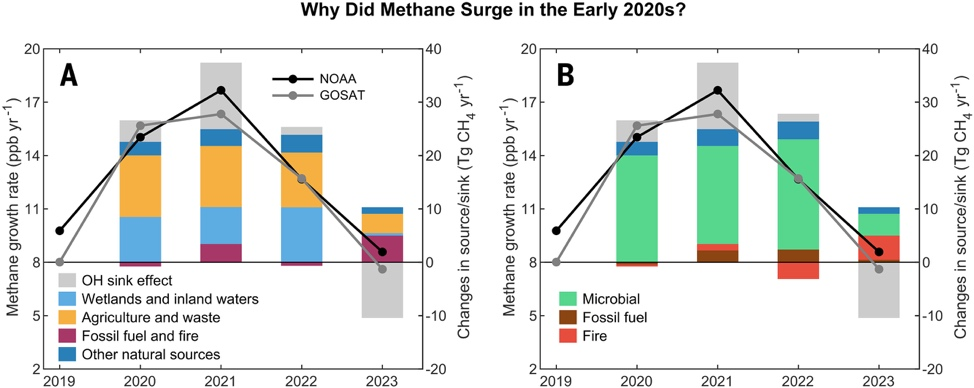 Fig. 1. Attribution of the early 2020s global methane surge. Recent changes in methane emissions and OH removal relative to 2019 for (A) different source sectors and (B) different processes.
Future Implications
Fig. 1. Attribution of the early 2020s global methane surge. Recent changes in methane emissions and OH removal relative to 2019 for (A) different source sectors and (B) different processes.
Future Implications
The findings show that future methane trends will depend not only on anthropogenic emissions, but also on natural methane sources, providing key scientific evidence for future targeted methane mitigation plans and climate change responses.
*This article is featured in PKU News "Why It Matters" series. More from this series.
Read more: https://www.science.org/doi/10.1126/science.adx8262
Written by: Akaash Babar
Edited by: Chen Shizhuo
Source: PKU News (
Chinese)