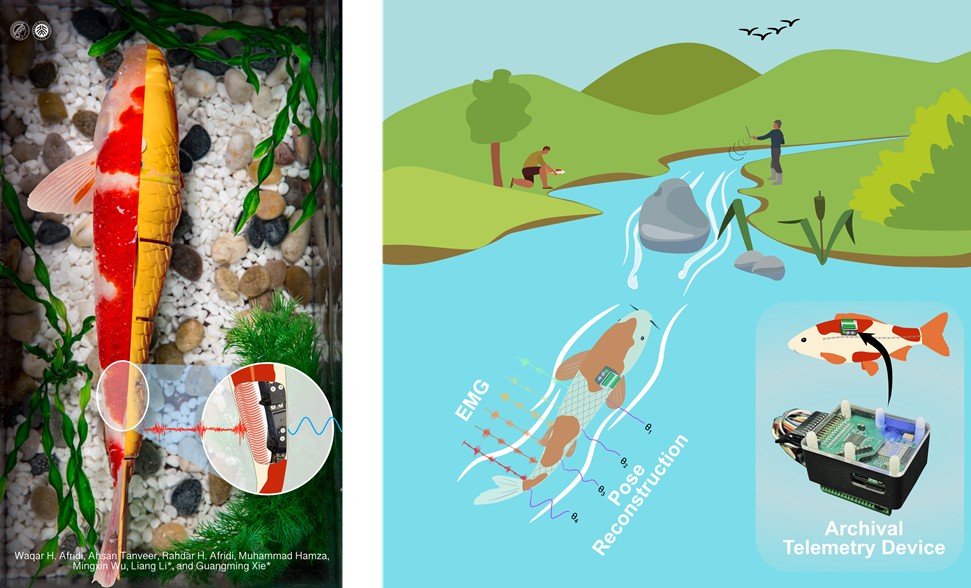
Peking University, April 27, 2026: Researchers at the Intelligent Biomimetic Design Lab at Peking University have developed a bio-signal framework showing that fish muscles do far more than generate swimming motion. In a series of studies led by Xie Guangming, Professor at the School of Advanced Manufacturing and Robotics, and carried out by twin brothers Waqar Hussain Afridi and Rahdar Hussain Afridi, muscle electrical signals were used to reconstruct body posture, infer surrounding flow conditions, and transfer biological principles to robotic systems. These findings open new directions in biological telemetry, locomotion research, and bio-inspired underwater robotics.

Figure 1. Recording fish muscle signals and converting them into body motion.
In the
first study, the team introduced an EMG-driven telemetry and inference system for freely swimming fish. Using a custom 16-channel device, they recorded intramuscular electromyography (EMG) signals alongside synchronized body kinematics under different flow conditions, including laminar flows and vortex streets. A deep neural network mapped these signals to joint angles, enabling accurate reconstruction of body posture. The same framework also classified flow regimes and swimming speeds, demonstrating that muscle activity encodes both motion and hydrodynamic information.
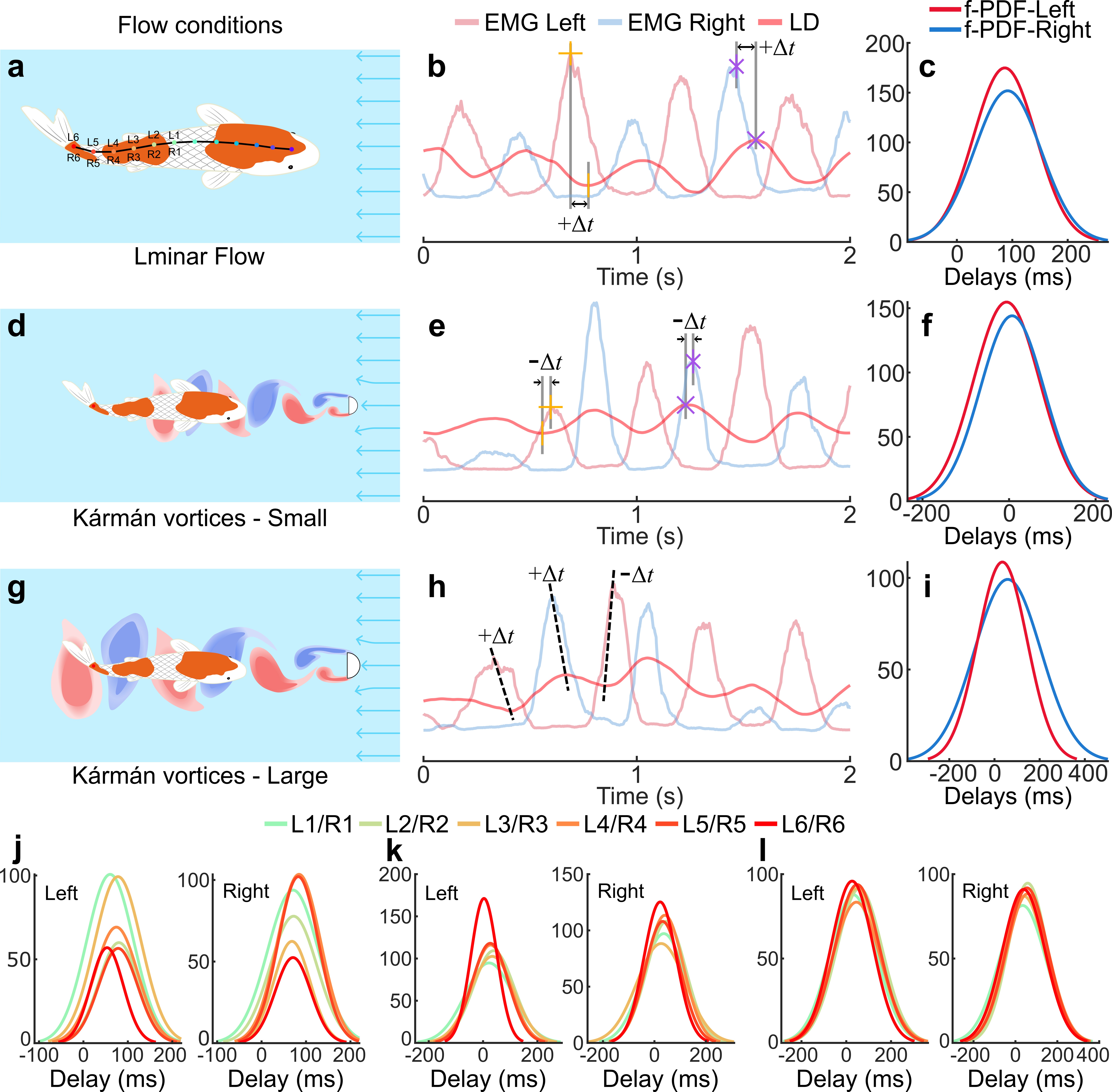
Figure 2. Muscle self-sensing enables hydrodynamic sensing in the fish's body.
The
second study explored whether fish muscles also act as sensors. Using synchronized EMG recordings and video-based kinematics in koi and carp, the researchers compared swimming in laminar flows and Kármán vortices. In smooth flow, muscle activity preceded body motion, consistent with propulsion. In vortical flow, however, this timing was sometimes reversed, with body motion occurring before muscle activation. This suggests that external vortices can first deform the body, after which muscles respond via muscle sensing. The results support the idea that fish muscles serve as both actuators and components of a sensing system.
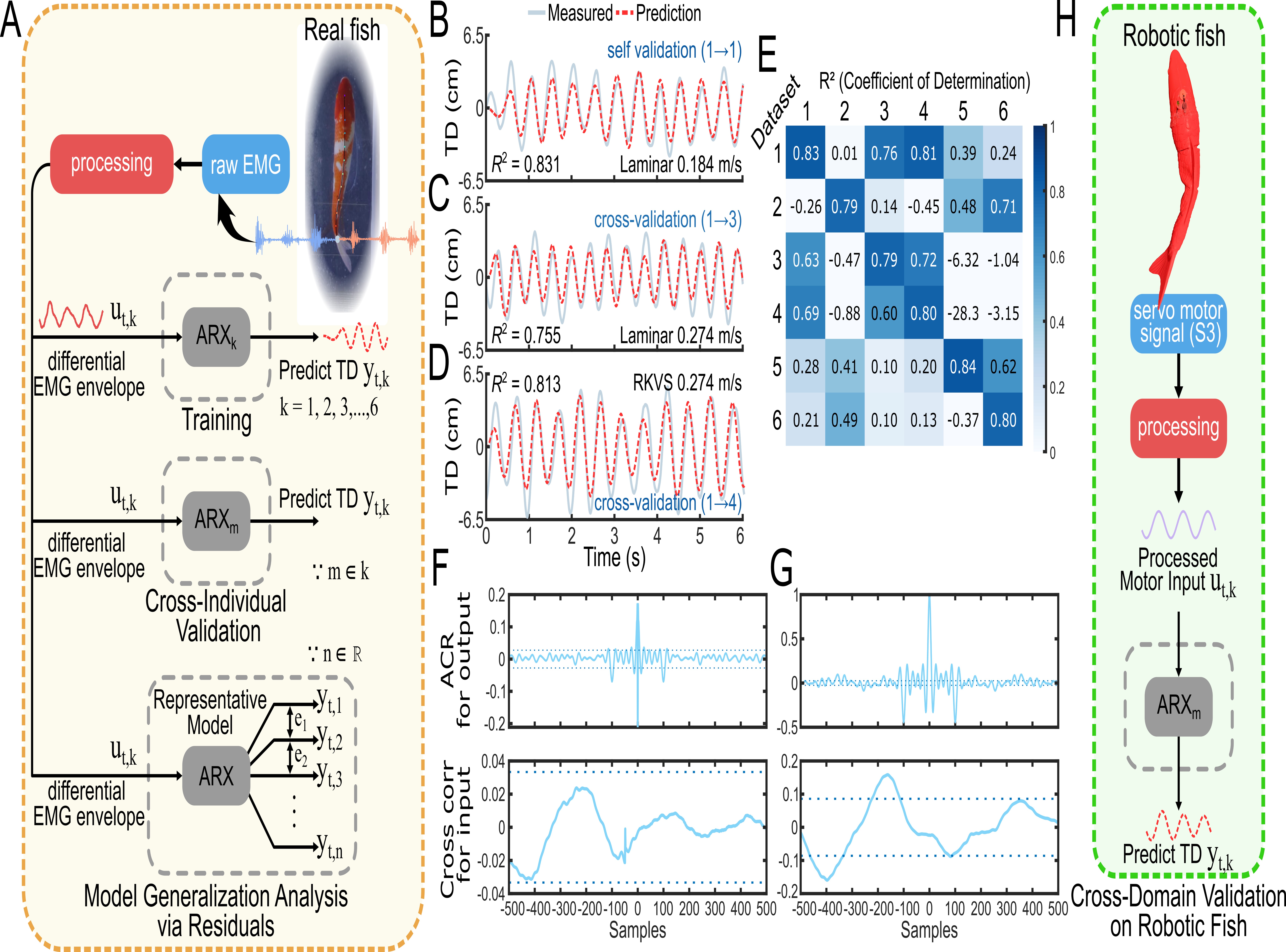
Figure 3. Bio-to-Robot Transfer of Fish Sensorimotor Dynamics via Interpretable Model.
In the
third study, these biological insights were applied to robotics. The team trained an interpretable system identification model using synchronized EMG and motion data from freely swimming fish. The model captured relationships between muscle activity and tail motion while extracting parameters such as delay, gain, damping, and natural frequency. Remarkably, a model trained only on fish data successfully generalized to a robotic fish, accurately predicting tail motion without robot-specific retraining and outperforming a deep learning baseline.
Taken together, these studies demonstrate a clear progression: muscle signals can decode motion and flow, reveal sensing capabilities, and inform robotic design. This work points toward a new generation of intelligent underwater systems inspired not just by biological form, but by the underlying sensorimotor dynamics that drive efficient behavior.
Read more:
(i) https://doi.org/10.1002/aisy.202501085
(ii) https://doi.org/10.1098/rspb.2025.0474
(iii) https://doi.org/10.1002/aisy.202501117
Written by: Akaash Babar
Edited by: Chen Shizhuo