Peking University, May 20, 2026: A research team led by Professor Zang Yinyin from Peking University, together with Professor Wang Yin of Beijing Normal University and international collaborators, has brought fragmented findings on autistic social functioning into a clearer developmental structure. Through the largest systematic review and meta-analysis to date on social functioning in autism, the team revealed that these differences are not isolated or scattered across separate abilities, but instead follow a hierarchical developmental pattern.
Why it Matters
Social functioning differences are a defining feature of autism spectrum condition (ASC), affecting approximately 1% of the global population and shaping communication, social interaction, and social adaptation. However, research and clinical practice have long approached these differences from separate directions: basic research has often examined specific social capacities, while clinical practice has focused more on observable social behaviors. This disconnect has made it difficult to integrate fragmented findings or translate them into effective support. By offering a systematic and integrated framework, this research helps bridge that gap and may improve the accuracy of autism screening, the design of targeted interventions, and the quality of support for autistic individuals worldwide.
Key Findings
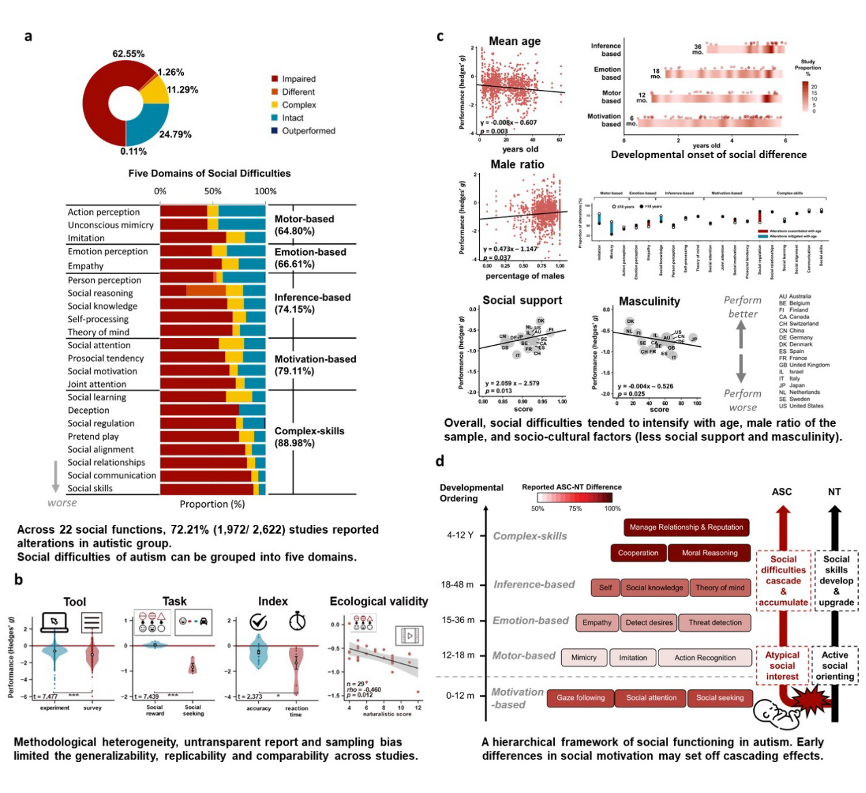
The study found that social functioning differences in autism are not isolated and scattered across different behavioral levels, but present as a systematically organized hierarchy. The 22 components of social functioning can be grouped into five core domains: motor, emotion, inference, motivation, and complex skills, as shown in the figure below.
Patterns of Social Functioning Differences in Autism.
From a developmental perspective, differences emerge the earliest in motivation-based processes at around 6 months, followed by motor, emotion and inference domains. As autistic individuals grow older, differences might further diverge in some domains, but learning from experience and compensatory strategies can help them improve. More importantly, the study has found stronger interdependencies among domains in autism, suggesting that changes in one domain might be closely related to development in multiple social functions.
Future Implications
Future studies should place greater emphasis on real-world social interaction, cross-cultural representation, and gender-sensitive analysis. In clinical settings, the study offers a useful reference for assessing social functioning, identifying more precise subgroups, and designing interventions that align with different developmental stages. At the policy level, it suggests that autism support should move beyond individual skills training and also focus on creating inclusive, supportive, and neurodiversity-friendly environments that better accommodate autistic individuals in everyday life.
*This article is featured in PKU News "Why It Matters" series. More from this series.
Read more: https://doi.org/10.1038/s41562-026-02457-w
Written by: Ricson Lee
Edited by: An Bingjie, Chen Shizhuo
Source: PKU News (
Chinese)