Peking University, May 20, 2026: In a silent war that has raged for millions of years, plants have evolved a sophisticated chemical arsenal to fight back against invading pathogens. Now, a team of researchers from Peking University and Tsinghua University has finally mapped out the blueprints for one of nature’s most effective deterrents, solving a biological puzzle that has baffled scientists for nearly half a century.
The study, published in the journal Cell, reveals how certain plants manufacture a potent compound known as debneyol. First identified in 1979 in tobacco and pepper plants, debneyol is a "phytoalexin"—a natural antibiotic produced by plants under stress. Although it was long recognized for its powerful ability to kill a wide range of fungi and bacteria, the exact instructions for how plants build it remained a secret until now.
 The Master Coordinator
The breakthrough came when Professor Lei Xiaoguang’s team at Peking University and Professor Liu Yule’s team at Tsinghua University identified the three specific enzymes that form the core of the debneyol production line: EAS, EAE, and EH1.
However, the real surprise was the discovery of a protein called MCD1, which is regulated by a molecular switch known as miR1919. The researchers found that MCD1 acts as a "metabolic organizer." Instead of letting the enzymes float aimlessly within the plant cell, MCD1 physically pulls them together into a single, high-efficiency production unit called a "metabolon."
This spatial organization creates what scientists call substrate channeling. By grouping the enzymes into a tight complex, the plant can pass chemical building blocks directly from one stage to the next. This prevents raw materials from being wasted on other, less effective defenses, ensuring the plant can rapidly mass-produce its chemical shield the moment it is attacked.
A Smart Defense for Global Agriculture
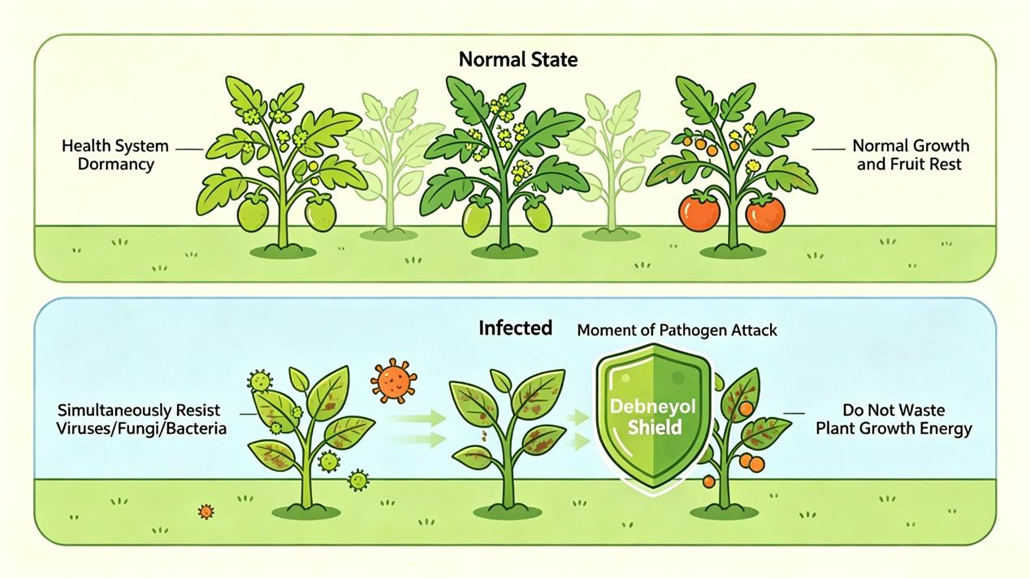
The implications for the future of farming are significant. The study proved that plants equipped with this optimized defense system show extraordinary broad-spectrum resistance, meaning they can simultaneously fend off viruses, fungi, and bacteria.
Crucially, the team discovered a way to make this defense "smart". By using a specific genetic switch, they can ensure the plant only activates its chemical shield when it detects an actual attack. This prevents the plant from wasting energy on defense during normal growth, allowing it to remain healthy and productive while staying ready for battle.
 The Path Ahead
This research provides a new toolkit for breeders looking to create "super crops" that require far fewer chemical pesticides. Beyond the field, the ability to reconstruct this entire pathway in a lab setting opens the door for using synthetic biology to produce debneyol on a commercial scale, potentially leading to new types of natural antimicrobial treatments.
"For nearly half a century, this chemical defense was something of a 'black box' in plant biology. By discovering how the MCD1 protein organizes enzymes into a high-speed assembly line, we finally have the blueprint to help crops shield themselves from a multitude of threats without the need for heavy chemical intervention," said Professor Lei.
Supported by the National Natural Science Foundation of China and the New Cornerstone Science Foundation, this work represents a major leap in our understanding of how the natural world uses chemistry to survive. It offers a more sustainable path forward for global food security, learning from the very plants that have been protecting themselves for eons.
Read more: https://doi.org/10.1016/j.cell.2026.04.021
Source: College of Chemistry and Molecular Engineering