Peking University, June 8, 2026: A new study published in
Precambrian Research by Jawad Shabbir, a PhD student at Peking University's School of Earth and Space Sciences under Professor Song Shuguang, addresses a critical yet poorly understood period in Earth's history. The Archean-Proterozoic transition witnessed global tectonic evolution, cratonization, glaciation, banded iron formations, and the Great Oxygenation Event—events linked to supercontinent formation. Focusing on the Yinshan Block within the North China Craton (NCC), the research challenges previous ambiguities by revealing two complete orogenic cycles driven by tectonic processes similar to modern Earth.
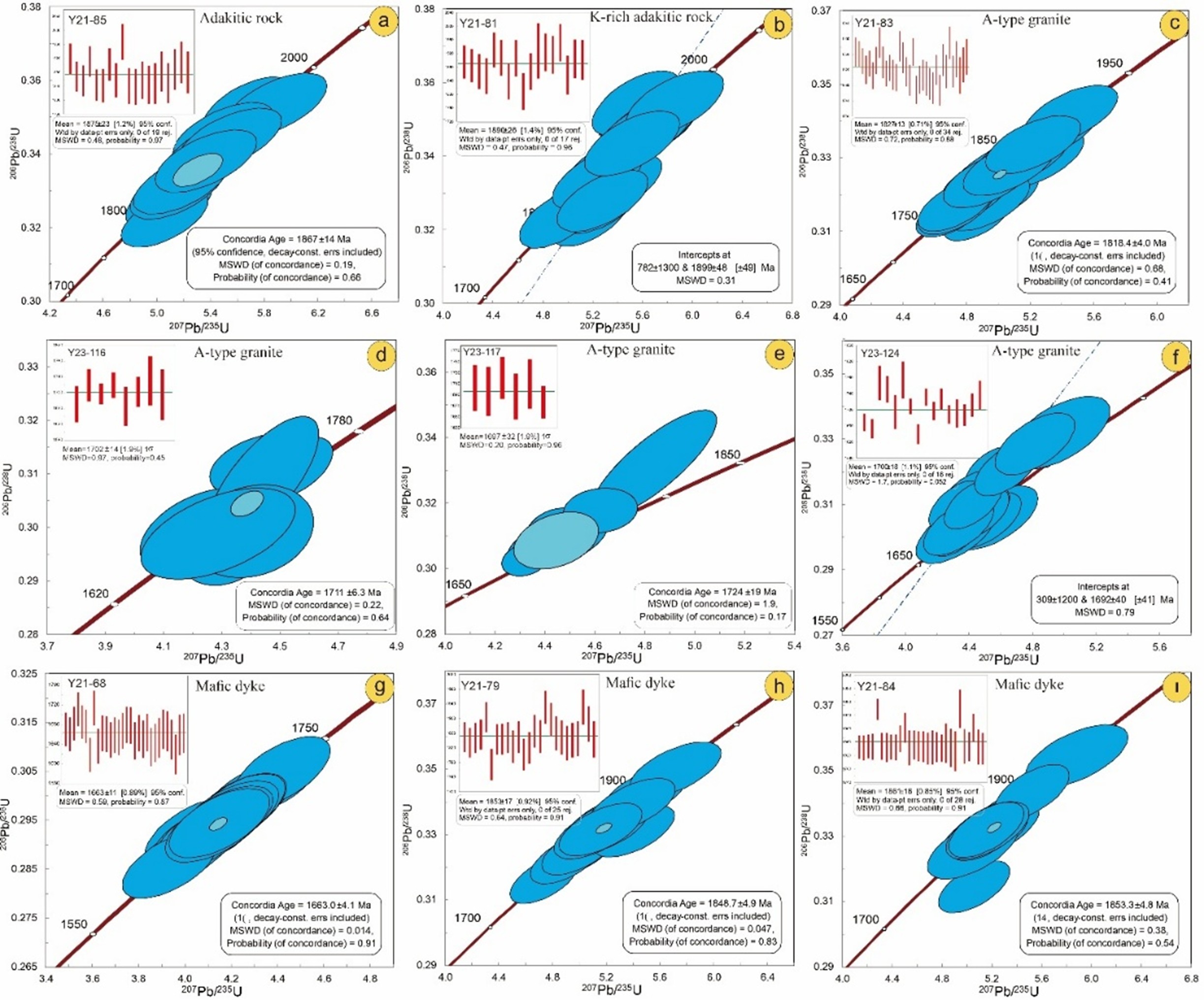
Zircon U–Pb concordia diagrams of adakitic rocks, A-type complex, and mafic dykes from the Yinshan Block.
Why It Matters
Decoding Earth's early continental crust formation requires understanding the Archean-Proterozoic transition, yet the geodynamic setting of many cratons, including the NCC, remains controversial. By analyzing post-collisional magmatic signals, this study offers rare insights into the mechanisms driving cratonization, supercontinent assembly, and the transition to the stable "Boring Billion."
Key Findings
Using whole-rock geochemistry, Sr-Nd isotopes, and zircon U-Pb/Hf isotopic analyses, the research team made three major discoveries:
1.
A Neoarchean Orogenic Cycle (2.7–2.35 billion years ago): In the Daqingshan area, the team identified a bimodal igneous complex. These rocks show signs of an extensional, post-collisional setting, where orogen collapse followed an ancient mountain-building event.
2.
A Late Paleoproterozoic Orogenic Cycle (2.2–1.6 billion years ago): The research team uncovered adakitic rocks, A-type complexes, as well as two distinct generations of mafic dykes. These record a second, later orogenic cycle linked to the assembly of the Columbia supercontinent, ultimately leading to cratonic stabilization.
By integrating both cycles, the study shows that the Yinshan Block experienced two complete episodes of collision and collapse, confirming that plate tectonic processes fundamentally similar to today's were already operating by the Paleoproterozoic cycle.
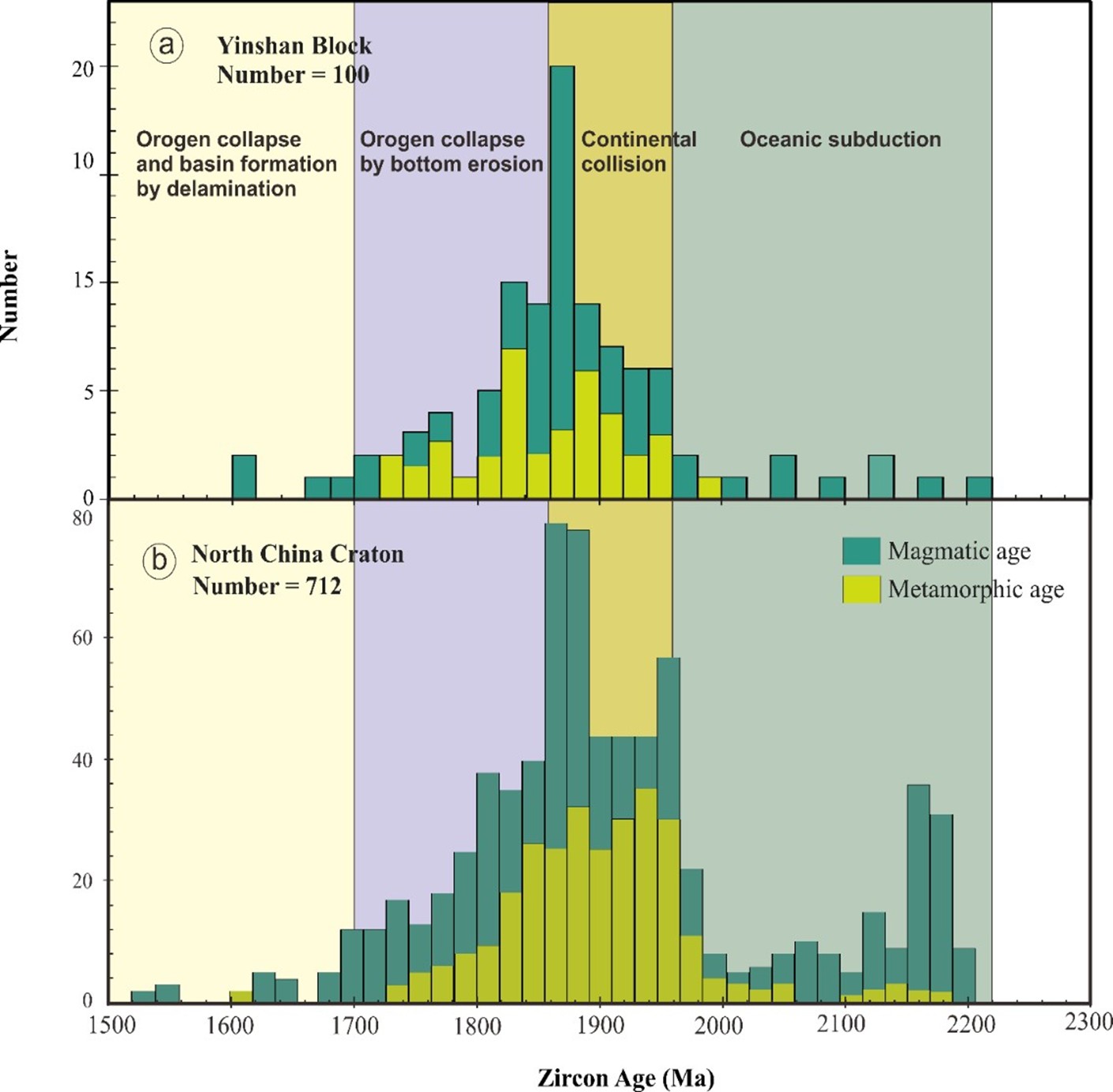
Histogram of magmatic and metamorphic age data from Yinshan Block and the North China Craton.
Future Implications
“This area serves as a natural laboratory for studying how continental lithosphere evolves through complete supercontinent cycles,” Dr. Shabbir notes. “What we see is a dynamic, repetitive process of mountain building, collapse, and stabilization—paving the way for a quieter Earth in the ‘Boring Billion.’”
The findings offer a robust tectonic framework for the Precambrian evolution of the NCC and have broader implications for understanding the assembly and breakup of Earth’s earliest supercontinents.
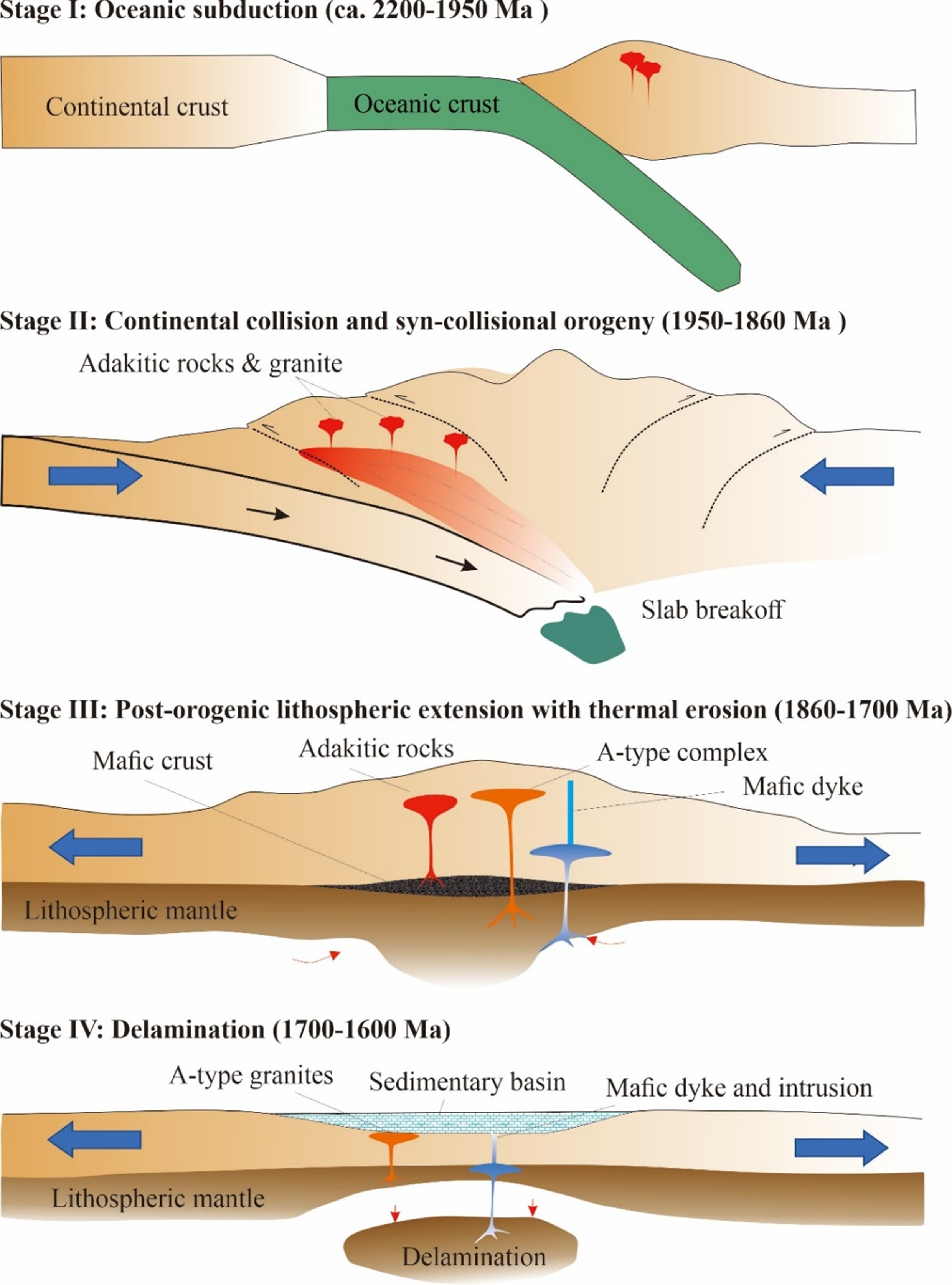
Schematic model illustrates tectonic evolution of the late Paleoproterozoic orogenic cycle and the generation of syn- and post-collisional magmas in the Yinshan Block.
*This article is featured in PKU News "Why It Matters" series. More from this series.
Read more: https://doi.org/10.1016/j.precamres.2026.108165.
Written by: Jawad Shabbir
Edited by: Chen Shizhuo